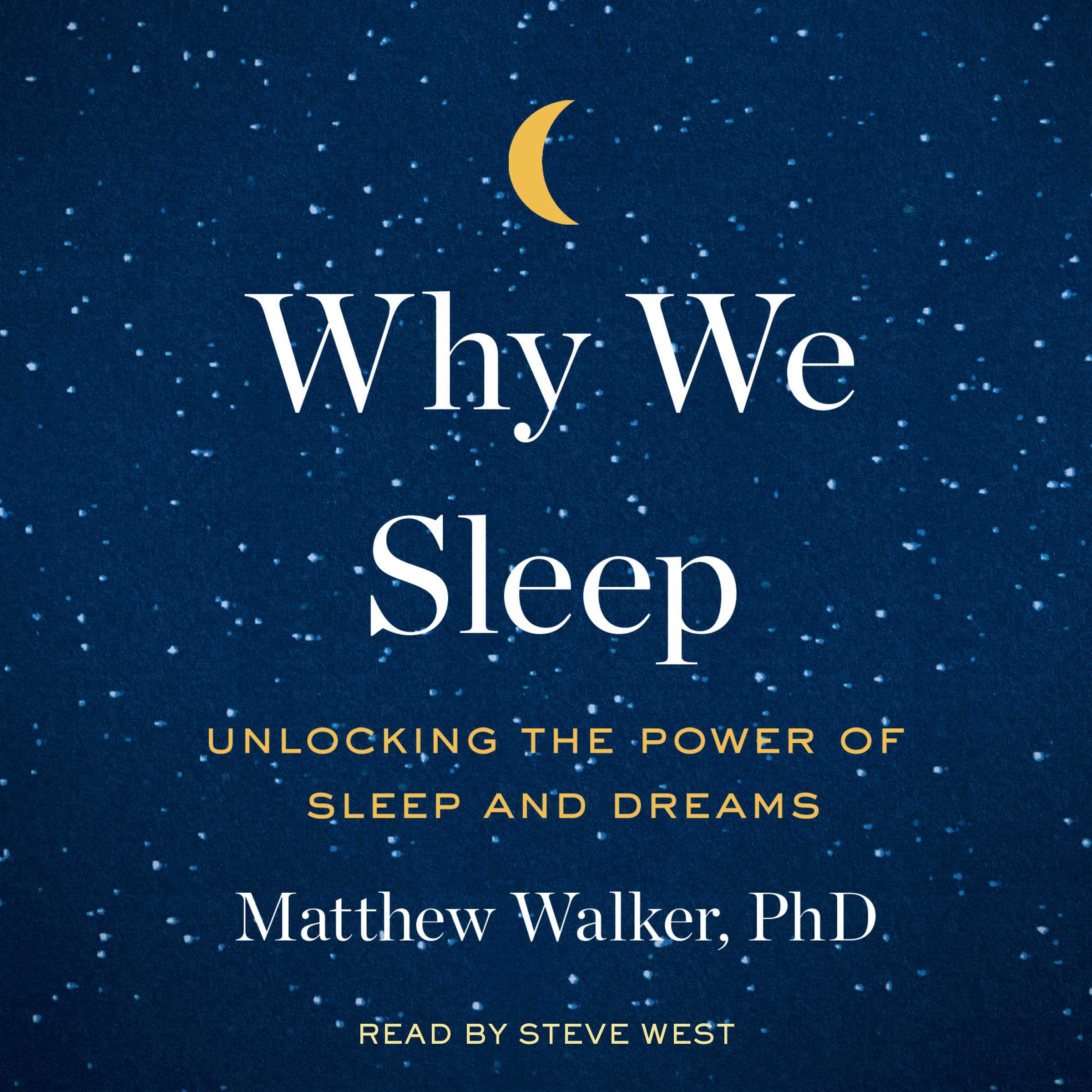
Why We Sleep: Unlocking the Power of Sleep and Dreams
4.7 | 34,009 ratings
Price: 19.68
Last update: 03-18-2026
Top reviews from the United States
- LenZenA Wake-Up Call for Better Sleep"I was once fond of saying, 'Sleep is the third pillar of good health, alongside diet and exercise.' I have changed my tune. Sleep is more than a pillar; it is the foundation on which the other two health bastions sit. Take away the bedrock of sleep, or weaken it just a little, and careful eating or physical exercise become less than effective, as we shall see."
― from “Why We Sleep: Unlocking the Power of Sleep and Dreams”
Matthew Walker's "Why We Sleep" is one of the two most important books I have read in my life1. Having done a little stock trading along with having survived several tech industry "death marches," things which are quite antithetical to good sleep, I had little idea just how destructive to your health lack of sleep is. A few years back, however, I began to hear that lack of sleep was correlated with diseases such as Alzheimer's, but this did not strike me as convincing since correlation is not causation. Indeed, a little later, I heard about this book at work but was somewhat ambivalent. It's just going to tell me that doctors think sleep is essential but are vague as to why were my thoughts.
Luckily I noticed an episode of Sam Harris's podcast "Making Sense" in which he interviewed Walker. Since Sam Harris is a figure whose judgment I highly respect, and I know he is very discerning about whom he invites on as guests, I decided there was probably more of value to say about sleep than I initially thought.
Correlation and Causation
Walker's book makes a compelling case that sleep is the bedrock of good health. He convincingly demonstrates that lack of good sleep can lead to downward spirals in health with the development of health conditions that make it hard to sleep, leading to more serious health conditions due to lack of sleep, making it even harder to sleep… and so on into a vicious cycle. Walker is careful to lay out in detail when the causal mechanisms are well understood, as in the case of Alzheimer's and cancer, and when lack of sleep is currently a suspect, although the exact causal mechanism has yet to be established. By the end of the book, I realized, however, that sleep is so foundational that even a mere correlation to some bad health condition is enough to make lack of good sleep a prime suspect worth considering as a cause.
Organization and Style
According to Walker, "Why We Sleep" is organized so that later chapters can be read without a strict need to read earlier ones first. Thus, if you use sleeping pills and want to know why you should not, he says it is okay to and, indeed, encourages you to jump to that section right away. That being said, I found the writing style so engaging (with a few minor instances of excessive detail) and the content so important that I read it straight through. Having read it this way, my sense was that the book frontloads its most important content: It explains in detail, with specifics such as the chemicals involved, why you feel more tired at certain parts of the day than others. To give you the motivation to get good sleep, the deleterious effects of lack of sleep also come near the beginning of the book.
The Enormous and Far-Ranging Effects of Poor Sleep
The effects of lack of sleep go beyond just affecting your physical health, however, and Walker shows just how destructive lack of sleep will be on your ability to learn new things. One of the most remarkable findings is that you need to get good sleep after learning new information. You cannot even get a single night of suboptimal sleep the first night, or some information will be lost permanently.
Conversely, if you get that first night of good sleep after learning something new, sleep on subsequent nights will continue to solidify what you have learned: all while you sleep! This is just one case where Walker details how, unfortunately, missed sleep cannot be well compensated for by more sleep later: Permanent losses are involved.
Dreams
Some of the most fascinating information in the book is on the role of dreams. Here we learn of their therapeutic qualities, including some of the underlying biochemistry involved. Discoveries here have led to a better understanding of PTSD, including better treatment methods. Walker also describes how dreams foster creativity by establishing connections between distantly related pieces of information stored in the brain. Here Walker includes a particularly fascinating anecdote of how Edison enhanced his creativity by waking himself from naps and immediately recording his thoughts.
Empathy For Different Circadian Rhythms
Throughout the book, Walker emphasizes how what we have learned about sleep has implications for how we should view people who may not have what seem like "normal" sleep patterns more empathetically. In particular, he emphasizes that teenagers want to get up and go to bed later, not due to laziness but because they run on a different circadian rhythm. It is something that is biologically hardwired into them. A consequence is that forcing school start times incompatible with this has devastating effects on how well they learn compared to well they could. Similar facts are true of people who are naturally "night owls" and run on different circadian rhythms than the rest of us.
Minor Flaws
Walker's book has only a few minor flaws:
1. Although he provides an excellent explanation of why most sleeping pills should be avoided, he does not mention whether this includes melatonin.
2. His discussion of the nationwide dollar impacts of poor sleep could be better presented. The unfortunate truth is that given the numbers we have heard spent on wars and, especially, financial bailouts and stimulus, rattling off numbers that are “merely” in the hundreds of millions or even low billions hits us in a place we are now numb.
3. Although Walker's discussion of creativity in the dream state and the state when just waking from dreams is a fascinating part of the book, I would have liked to see some discussion of how objectively accurate intuitions are during these moments. Anecdotally, I used to joke that my best ideas came to me during this time or not at all. Sometimes, however, the thoughts just turned out to be overconfident upon more profound reflection. Is that true for just me, or is it true for people, generally speaking?
Conclusion
Overall, Walker's "Why We Sleep" is a must-read for anyone who sleeps: in other words, everyone. This book will not only absolve you of any guilt associated with prioritizing sleep, but it will also arm you with the knowledge to make the best choices for your physical and mental health. Walker guides you through the critical benefits of sleep, from its integral role in memory and creativity to its power to process and put to rest the day's experiences: especially the more troubling ones.
While the damaging effects of lack of sleep seem exponential, Walker argues that some of the most significant benefits come in the final two hours. Thus getting eight full hours of sleep is crucial. After reading this book, you will not want to miss a full night's sleep again.
To help you achieve a full night's sleep regularly, Walker provides 12 concrete steps in an appendix. Some of these suggestions are initially counterintuitive. For example, Walker maintains that a cooler room temperature of around 65F is best for optimal sleep. Already, I've been putting this and his other advice to the test, and the results seem promising. - Desmond YuenWhy We Need Sleeping?I became interested in this book because I wanted to learn how to sleep better. Did it answer my questions? Most of them, I would say.
The book is divided into four parts. Readers can choose to read each part independently and not in a specific order. That’s exactly how I read it—out of order and focusing on topics that interested me most—such as jetlag, sleeping pills, dreams, and healthy sleep.
Part 1: This Thing Called Sleep
What I liked most about this book is how it dispels myths about sleep. Let's start with sleeping pills. Most of the sleep aids on the market are based on Melatonin. Essentially, melatonin helps regulate when sleep occurs, but it doesn’t put you to sleep. Using melatonin for jet lag may not guarantee sleep, but it significantly improves the chances by providing the right timing signal. Another common misconception is that drinking alcohol before bed helps us sleep better. It actually has the opposite effect.
Part 2: Why Should You Sleep
I used to hear stories about great people who only slept a few hours a night and got more done than most folks. However, even people like Bill Gates now say that getting eight hours of sleep is important. Sleep deprivation can lead to serious problems. People who don’t get enough sleep tend to lose productivity, and their health can suffer as their immune system weakens. A more dangerous situation is when sleep deprivation affects our ability to drive safely.
Part 3: How and Why We Dream
I always try to interpret my dreams, especially scary ones, to understand what they mean. The author examined dreams from a scientific perspective. It's almost like fortune telling when we try to decode a dream. However, with scientific data, they showed that people become more creative and better at solving difficult problems during dreams. He shared examples from well-known individuals like Thomas Edison and Paul McCartney—very interesting findings. I think I need to dream more so I can boost my creativity!
Part 4: From Sleeping Pills to Society-Transformed
This part was my favorite because it answered many of my questions. With modern society, we face increasing distractions every day. Aside from computers at work and home, we have numerous electronic devices like iPads, cell phones, and smartwatches. Spending too much time on these devices before bed isn’t healthy. It was eye-opening to learn that factors such as the blue light from LED screens, room temperature, and lighting can all impact our sleep.
The author clearly states at the beginning that his book isn’t meant to be a self-help guide, nor is it targeted at treating sleep disorders. However, he includes an appendix titled "Twelve Tips for Healthy Sleep."
This book is grounded in data and facts. I learned a lot from reading it and thoroughly enjoyed the experience. For those who aren’t interested in all the experimental details, you can still gain valuable insights from it.