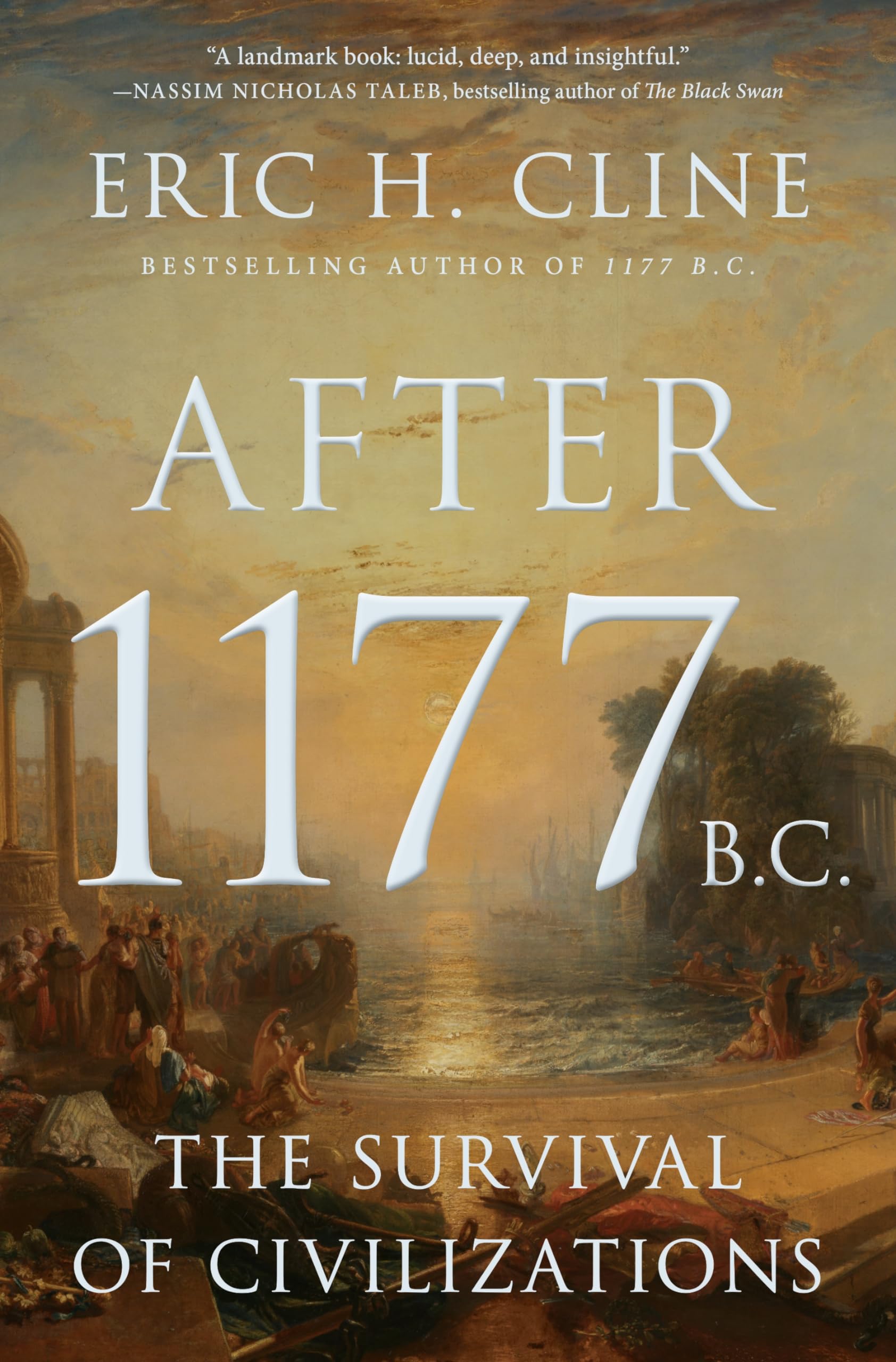
After 1177 B.C.: The Survival of Civilizations (Turning Points in Ancient History)
4.4 | 361 ratings
Price: 17.05
Last update: 11-29-2025
Product details
- ASIN : B0CRN93QFN
- Publisher : Princeton University Press
- Accessibility :
- Publication date : April 16, 2024
- Language : English
- File size : 18.7 MB
- Screen Reader : Supported
- Enhanced typesetting : Enabled
- X-Ray : Enabled
- Word Wise : Enabled
- Print length : 338 pages
- ISBN-13 : 978-0691255477
- Page Flip : Enabled
- Part of series : Turning Points in Ancient History
- Best Sellers Rank:#25,335 in Kindle Store (See Top 100 in Kindle Store)
- Archaeology (Kindle Store)
- Archaeology (Books)
- Ancient Early Civilization History
- Customer Reviews:4.44.4 out of 5 stars(377)
Top reviews from the United States
- mmmEasy read, great for learning about the pastExcellent read. I’m finding out that history is more than interesting. Easy to understand and follow. References are great for expanding your interests.
- Best ReviewerInteresting, quick read. But could use maps and quantitative support for arguments.Cline's first book 1177 BC essentially argued that there was a bronze age collapse about 1177 BC, perhaps in part because some peoples starting using iron instead of bronze. Also, there was drought, war, etc, which caused the collapse of great societies like ancient Egypt.
In this sequel, Cline kind of reverses course a little, and says, "Well, maybe things didn't completely collapse. Maybe, some societies along the Mediterranean kept on going". So this "dark age" was completely dark. The book could benefit from maps to show the areas he is talking about. Also, he argues using words, but no numbers or figures. If there was a partial collapse in some areas, and a more complete collapse in other areas, could this be demonstrated using graphs which show the total population of each area over time? Of course, it's hard to know this, but if you really have no idea about how many people live in an area, how can you say there was a collapse? If you are arguing a complete or partial collapse based on trade networks, etc., can you demonstrate average number of ships travelling between various ports over time? Or numbers of artifacts coming from overseas? Could you create a map which displays population density in each region over time? Could you show a map which would display literacy in each area over time? (apparently, there was a loss of literacy in the Greek world after linear B and before an alphabet based on Phoenician script). I get that it's hard to get all these numbers. But, if you can't quantify all of this stuff, isn't this all a bunch of hand-waving, to say "well, things collapsed a lot in some places, and not so much in other places". - RicoNot an easy read but fascinating history.This is an almost scholarly book with hundreds of citations to support the author's statements. If you've ever heard that the 'mysterious Sea Peoples' were responsible for the ending of the Bronze Age kingdoms you will be severely corrected. The end of the Bronze Age and the Beginnings of the Iron Age civilizations is a complex and varied story. The author did a good job of discussing this story by region to keep it understandable but that isn't entirely possible because the different surviving kingdoms and new civilizations are very intertwined. Again, 200 years climate change played a big role in the Bronze Age collapse with many kingdoms running out of food and then losing their citizens and then being overtaken by other kings with an historic grudge. But, other kingdoms and social networks survived because they were not as affected by the climate change and could live (and farm) without their king. Or, they had learned to create international style trading corporations that were more flexible and robust than the previous trade amongst kingdoms. This robustness grew as civilized society became more 'complex' in a mathematical way. During the Bronze Age, trade was mostly between kings who wanted things like gold, pearls, wood for their self-aggrandizing structures, and metals for war goods. After the Bronze age, trade was about what all peoples needs for housing, roads, food, and, of course, war metals. I'm sure beer and wine are a big part of trade too! Trade became more robust because it was about serving the various real life needs of everyone - not just the elite kings and priests. Complexity bred robustness. The author talked a little about this but from my reading he really doesn't understand the concept. Kudos though for him discussing it. This social complexity was also working in the general civilization. In fact, one of the main non-complex societies, Egypt, began their long term fall during this period. The advent of a universal alphabet was also part of the growth of this period. During the Bronze Age a universal alphabet was not needed because, well the kings didn't have the time to learn anything new. But, during the Iron Age, trade was between traders, no so much kings, and a universal alphabet seemed a good idea. And, it greatly aided in the robust, complex, growth of European civilization. Again, in this book there is very little discussion of the common peoples, farmers, wifes, households, slaves, and others. I think part of this is because there is little archaeological record but also, it is because archaeologists and historians don't care about the common people of the age. Who wants to study the poor and the merchants when there are mummies, soldier graves, gold and ceramics, and large administrative stone structures to uncover! Even so, I learned a lot about western and near east history. I wonder what was happening in the rest of the world?
- LaNinaMegHistory buffLove History and to read. Came in excellent condition and delivery.
- GasserA book about the Iron Age winners and losers should include more about iron's roleWhile I think Cline makes sound arguments about why some Near Eastern and Middle Eastern civilizations thrived rather than just survived in the early Iron Age, there was little discussion on what role iron itself played in these varying outcomes. For example, is it clear the Iron Age "winners" manage to take better advantage of the new technology than the others, either through earlier and more widespread adoption, enriching themselves by controlling the sources of iron ore, its trade routes, or developing a reputation for producing superior iron products? There's some discussion the Cypriots and perhaps the Phoenicians did so, but nothing comprehensive about the role iron may have played in the outcomes of the other cultures discussed. Perhaps there's not sufficient archeological evidence for a more general discussion on this point but it seems negligent on Cline's part to not mention it needs to be more fully investigated.
- RandyGreat bookGreat book, highly recommend anything by him on this subject.
- Ronald SpitzerEven When History Ends Things Go On!This is a good follow up book as what happened after the end of civilization in 11777 B.C. book. The findings since my college classes in the late 1970s have re-written the development of the Iron Age. It is fascinating how the different peoples handled coming through, transition and adaptation to the new conditions and lengthy drought. Recommended
- DanStalling, Staying or Starting Over?A moral tale, told with expertise, intellectual integrity and well-bundled information. This is a sequel with a story of its own to tell.