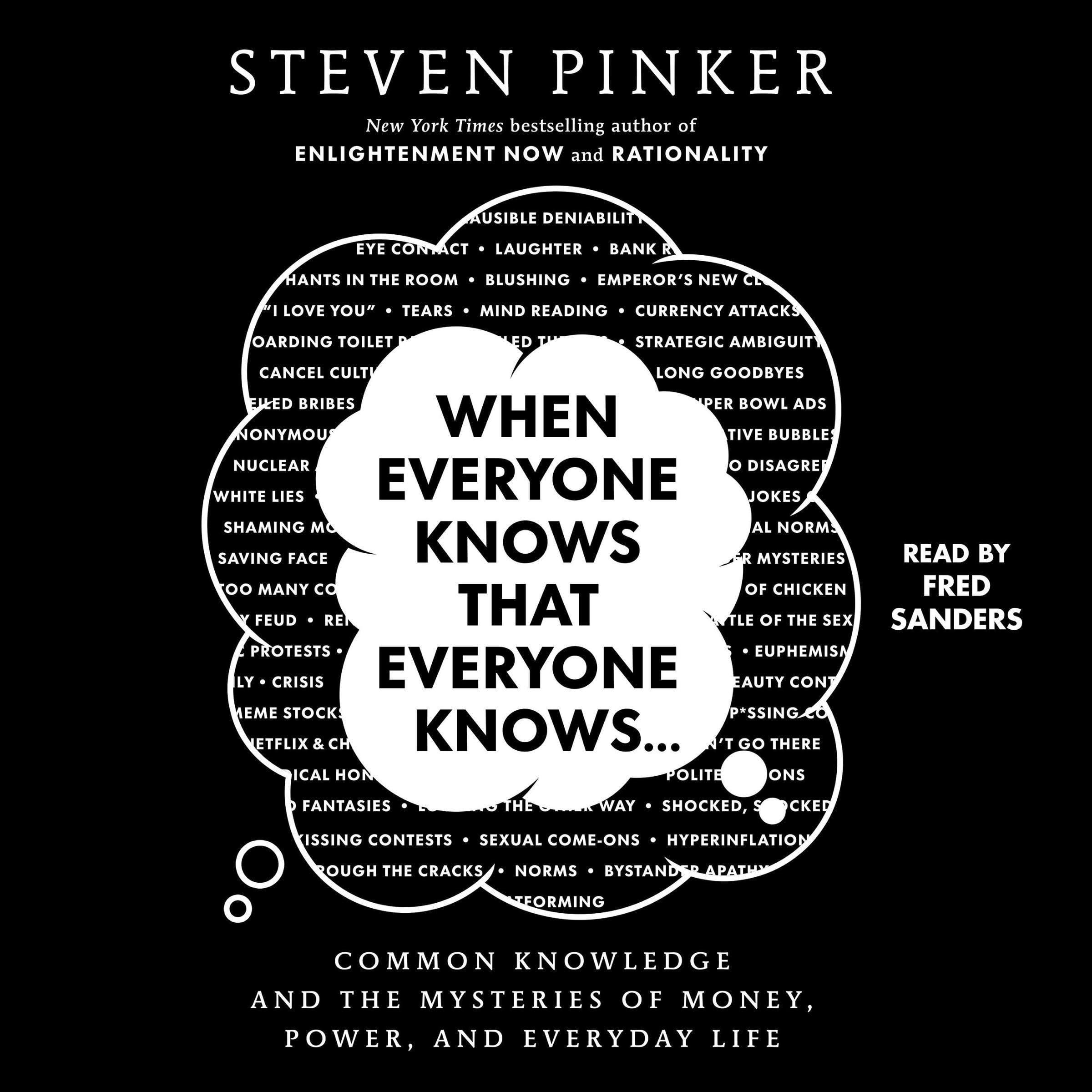
When Everyone Knows That Everyone Knows . . .: Common Knowledge and the Mysteries of Money, Power, and Everyday Life
4.2 | 280 ratings
Price: 17.05
Last update: 02-16-2026
Top reviews from the United States
- RobinInteresting and entertainingThe first couple of chapters are a bit of a slog. That is, they are a bit academic and slow going. They required my thoughtful and careful reading to ensure that I understood what he was saying and his examples. But it was well worth it. The book provided a unique perspective. And the author has a great sense of humor (I laughed out loud several times). In the end, it was very entertaining and interesting.
- H. G. Heren IVCommon Knowledge, Complex JourneySteven Pinker’s When Everyone Knows That Everyone Knows starts out with the kind of clarity and charm that makes you think you have mastered the entire field of epistemology before your coffee even cools. The introduction is crisp, accessible, and delightfully free of any need to diagram sentences on a whiteboard. The conclusion, for its part, returns to this friendly tone and wraps everything up so clearly that you may briefly suspect you are some sort of latent genius who could have written the book yourself if only you had started just a little earlier. These are comforting illusions. Treasure them.
The middle of the book, however, is where Pinker politely but firmly closes the door, rolls up his sleeves, and proceeds to reenact his years in graduate school for you. The narrative shifts from broad, smooth general audience prose to an intellectual deep dive that feels like following an Olympic swimmer across the English Channel while you dog paddle heroically behind. The topic at hand is common knowledge, which is deceptively simple in the abstract. Pinker approaches it in a structured, logical, and entirely coherent way. The trouble is that logic, when delivered in large and concentrated quantities, has the unfortunate tendency to make even diligent readers gaze longingly at nearby windows.
This is not to say the book is dull. Pinker retains his trademark wit and precision. He organizes his argument as neatly as a mathematician lining up proofs, and the central thesis is supported throughout with admirable rigor. The problem is simply that rigor is more enjoyable in moderation. Pinker offers it to you in something closer to an academic buffet, complete with every related concept you never knew existed and may politely hope never to encounter again after finishing the chapter.
Still, the journey is worth it. If you commit to the middle sections and resist the urge to wander off in search of lighter reading, you end up with a much deeper appreciation of how humans build shared understanding. Pinker guides the reader from simple examples to complex implications, then back to broad conclusions in a satisfying loop. It is genuinely impressive how he keeps the material as engaging as possible given the intricacy of the logic processes he explores.
In the end, When Everyone Knows That Everyone Knows succeeds both as a thoughtful academic work and as an accessible introduction to a topic that influences everything from social norms to geopolitics. Just be prepared for the fact that the clarity at the beginning and end is your warm blanket, and the middle is your brisk intellectual cold shower. Pinker is a generous guide, but he does expect you to keep up. - Kevin StecykAn Interesting and Thought Provoking BookI thoroughly enjoyed reading When Everyone Knows That Everyone Knows …: Common Knowledge and Mysteries of Money, Power, and Everyday Life.
I had never given much thought to thinking what others thought that I thought and so on. It’s interesting how common knowledge shapes the dynamics amongst different parties. The results can subtle or substantial, depending upon what is at stake.
I am still processing what I have read. This book takes some thinking and reflection.
For those who enjoy learning about people, I highly recommend Steven Pinker’s book. - A MEntertaining Game-theory puzzles and some pretty trivial discoveries in social psychologyThe chapters in the first part of the book present logical and game-theory puzzles, most of which are well known. Readers who are not familiar with these puzzles will enjoy excellent explanations. The later chapters present experiments that the author did with his students. Like many other discoveries in social psychology, most of them are trivial. The authors also present some “bombastic” ideas, such as Aumann’s claim that rational people cannot agree to disagree. This idea is based on the so-called Bayesian theory of belief (first proposed by Ramsey), according to which we assign probabilities to our beliefs according to the Bayesian formula. The author overlooks the extensive criticism of the idea that we assign probabilities to theories (i.e., generalizations) in contrast to events. For example, in 1963, Popper presented the following Agassi’s paradox: Consider two well-accepted theories, such as Quantum mechanics and Einstein’s Relativity. Both should have a high probability, much larger than 0.5. Now consider the theory “either quantum mechanics or Einstein’s relativity is true”. According to the probability calculus, it should be equal to the probability that the quantum mechanics theory is true, plus the probability that Einstein’s theory is true, minus the probability that both are true. But these two theories are inconsistent with each other, so the probability that both are true is zero. Therefore, the probability that either one is true should be higher than one, which is impossible.
- Edgar AlzatePinker loves facts!What’s great is that I can skip chapters back & forth ! Interesting opinion backed by facts as Pinker always does.
- ScottAnother masterpiece, well presented by AmazonStephen Pinker is brilliant, and for me difficult to keep up with, but worth the effort. The product/ format I purchased is of excellent quality and is certainly of value.
- William OrrPinker Doesn’t DisappointI own every commercial work done by Pinker. He is absolutely brilliant and optimistic about things even in today’s world. This book I believe is one of his better.
- Jonathan P. ElksStarted well, then faded awayI made it through the first 200 pages. I thought the author was going somewhere with this but the book faded away.