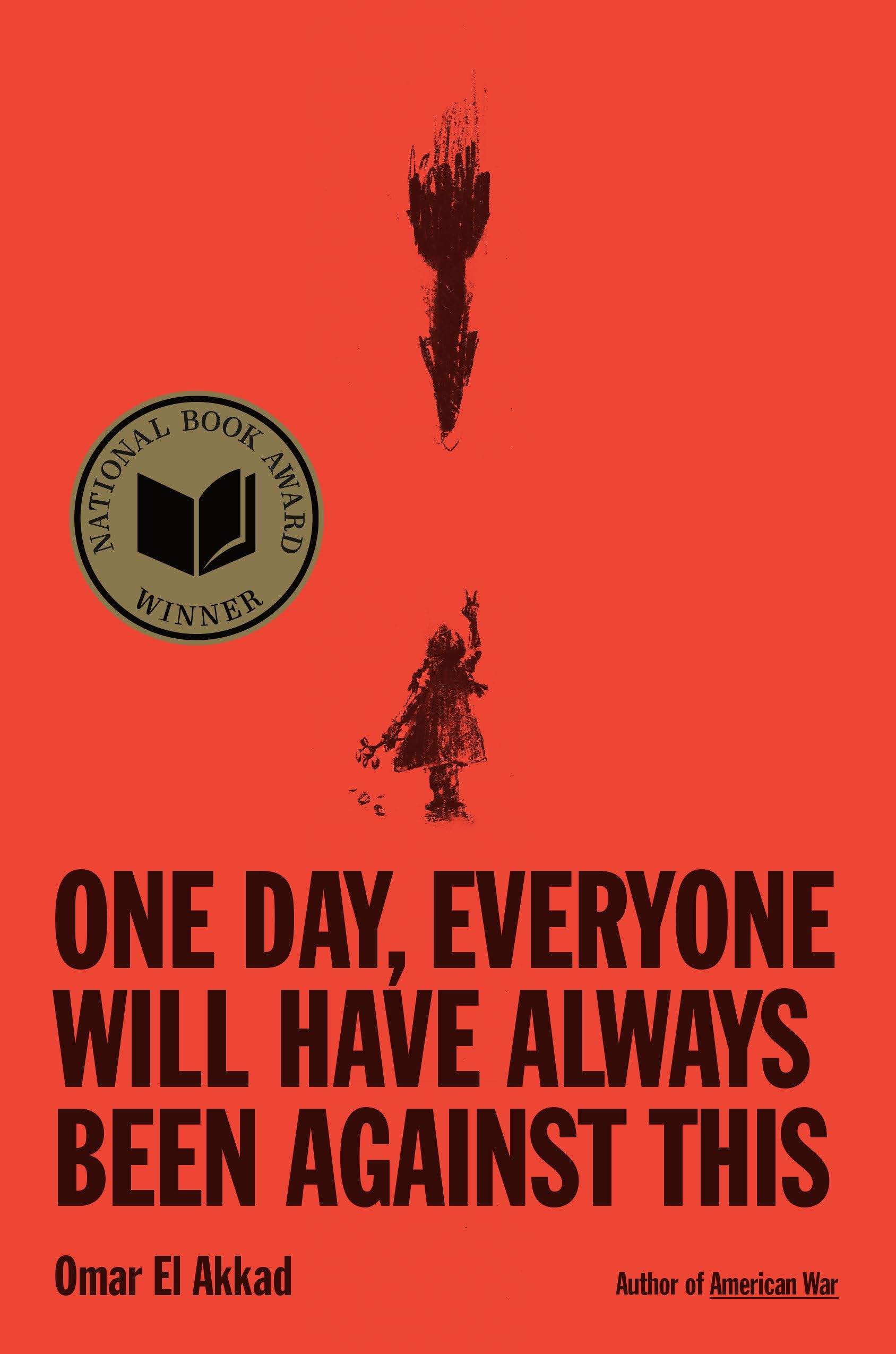
One Day, Everyone Will Have Always Been Against This: National Book Award
4.6 | 2,302 ratings
Price: 18.05
Last update: 01-30-2026
Product details
- Publisher : Knopf
- Publication date : February 25, 2025
- Language : English
- Print length : 208 pages
- ISBN-10 : 0593804147
- ISBN-13 : 978-0593804148
- Item Weight : 9.6 ounces
- Dimensions : 5.77 x 0.87 x 8.54 inches
- Best Sellers Rank:#277 in Books (See Top 100 in Books)
- Middle Eastern Politics
- Democracy (Books)
- Memoirs (Books)
- Customer Reviews:4.64.6 out of 5 stars(1,853)
Top reviews from the United States
- Mirela SetkicThe most powerful and beautifully written book of 2025!This book is 1000/10, highly recomment, must read!!! This is my second copy, which I am gifting to someone. My own copy was a pre-order back in February, from a local book store. Initially, I was really afraid to read it because I was too scared to feel the emotions I thought this book was going to bring out in me. It did make me feel deep sadness, but it also made me feel seen and not alone during a time when so many people are choosing to not to see the genocide in Gaza. Omar El Akkad is an incredible author who has a way of finding words to describe things/ideas/feelings that are way bigger than words. His work makes our world a better place.
- Nicholas McCaneStop what you’re doing and read this.One of the realest books I’ve ever read. A letter to you and I, and a gut punch to America and some other countries. And guess what? We deserve every word. This was a quick read that pointed a mirror at our hypocrisy, complacency, and involvement in the hatred of minorities and the current genocide of the people in Gaza. This is an important book, and I think everyone should read it. The book was very well written. Too bad that the people who should read this most likely will not. Here are two powerful quotes from the book.
“It is a reminder that, in times like these, one remarkable difference between the modern Western conservative and their liberal counterpart is that the former will gleefully sign their name on the side of the bomb while the latter will just sheepishly initial it.”
“The same people who did the killing and financed the killing and justified the killing and turned away from the killing will congratulate themselves on doing the right thing. It is very important to do the right thing, eventually.” - Art CummingsOne of the most honest and important books I’ve readAn indictment pure and simple and a call to everyone of conscience on the sidelines. I’ve read it as part of a book group and recommended it to several people. Beautifully written and thought inducing.
- marcellaA must read - but too longThis is a very painful and beautifully written book because it is spot on and I'm not better than everybody else. A must read. However, as is so often the case with non-fiction books, the point(s) could have been made just as effectively in half the number of words, or even a long magazine article.
- LaLaBoomLiteracy at it's best...Wowza, what a fantastic book. Superb writing. Sad, informative, I LOVE this book. Even the title is excellent.
- CMH75Brilliant CritiqueOne of the most important books of this era. An honest and beautifully written critique of contemporary society.
- Adley B.Thought Provoking--even if you don't agree with him....be prepared to be challenged and the author is to be applauded for his courage to go against the grain. It was eye opening for me and I recommend that others read it as well. You don't have to agree with him, but his perspective is important and should be part of discussions on various issues--past and present. Of note, is his descriptions of how those in distress are lost in the narratives.
- Alicia CrumptonA Moral DilemmaEl Akkad, O. (2025). One day, everyone will have always been against this. Alfred A. Knopf.
Omar El Akkad is a Canadian journalist and author who currently lives in Portland, Oregon.
El Akkad begins with a striking assertion: "Rules, conventions, morals, reality itself: all exist so long as their existence is convenient to the preservation of power. Otherwise, they, like all else, are expendable." His core premise: power structures will discard even fundamental principles when they no longer serve their interests. He explores how this preservation of power requires the classification of certain groups as "other" or "nonhuman" to justify violence—a pattern repeated throughout history across many nations. When discussing the United States specifically, El Akkad identifies a profound contradiction: Americans simultaneously hold the "belief that one's nation behaves in keeping with the scrappy righteousness of the underdog" while ignoring that the "most powerful nation in human history is no underdog, cannot possibly be one." El Akkad notes that the "immense violence implicit in the contradiction will always be inflicted on someone else"—those designated as outside the protected circle of humanity. Horrifically, he observes, "the same people who did the killing and financed the killing and justified the killing and turned away from the killing will congratulate themselves on doing the right thing... there will be those who say it was all the work of a few bad actors... to avoid contending with the possibility that all this killing wasn't the result of a system abused, but a system functioning exactly as intended." Even so, he concludes on a note of possibility: "Even during the worst of things... courage is the more potent contagion... it is always possible to stop looking away."
In this memoir emerging from experiences as a wartime journalist, El Akkad eloquently exposes the intricate justifications employed to maintain power amidst contested claims to moral high ground. He reveals how power structures craft narratives that legitimize their actions while dehumanizing others, creating a framework where violence becomes not just acceptable but necessary. As these justifications grow increasingly transparent, ordinary people begin to see through the duplicity. The contradiction between proclaimed values and actual behaviors becomes impossible to ignore, leading to an erosion of trust in the entire system. This loss of trust represents not just disillusionment with specific policies or leaders, but a fundamental questioning of the moral framework that allows such contradictions to persist. El Akkad suggests this moment of recognition—when people refuse to look away—contains the potential for transformation, as the courage to confront uncomfortable truths can spread more rapidly than the willingness to accept convenient falsehoods.