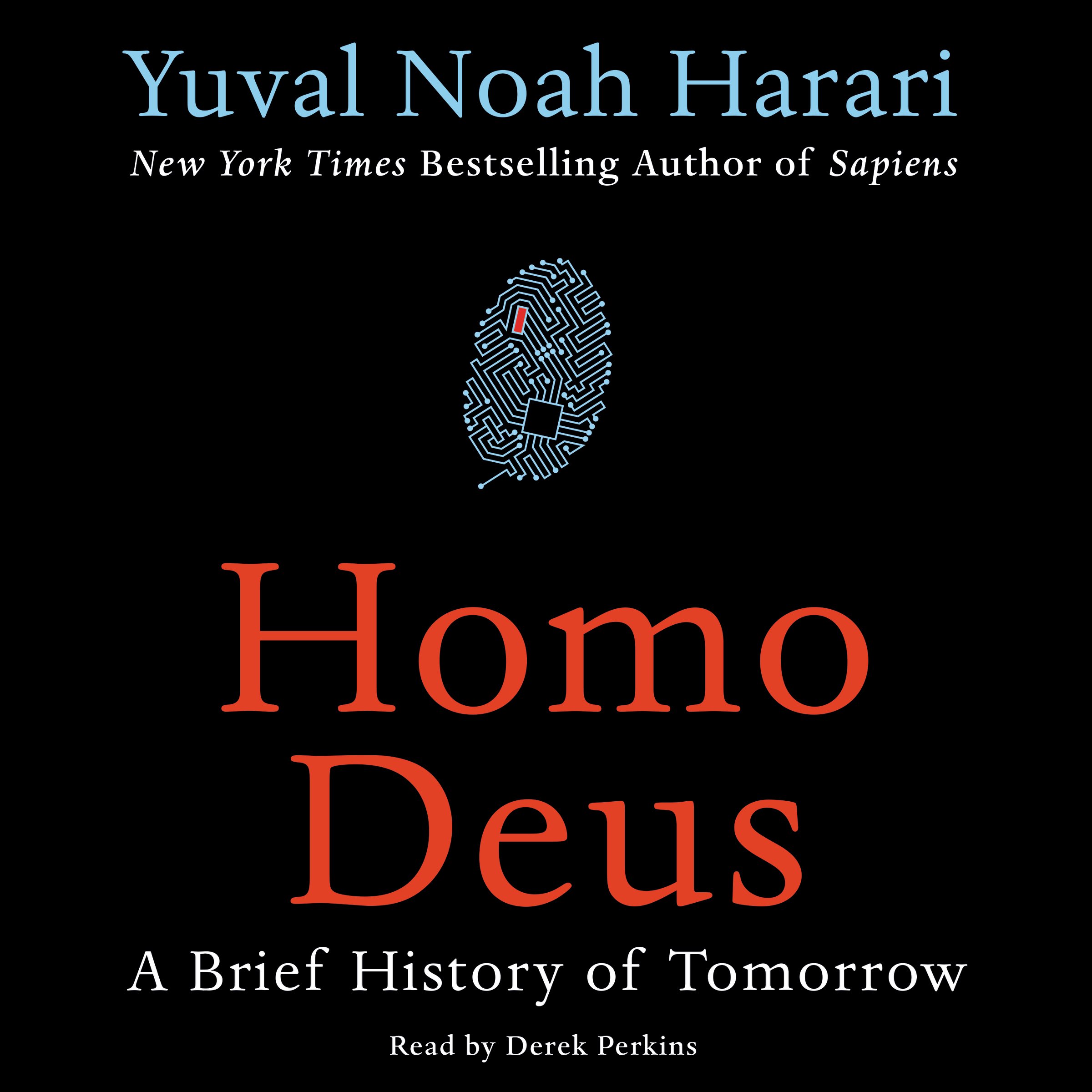
Homo Deus: A Brief History of Tomorrow
4.5 | 37,606 ratings
Price: 23.62
Last update: 02-05-2026
Top reviews from the United States
- PHILLIP J WESLEYThought provoking, educational, and entertaining.It's a must read after reading Sapiens.
- Dave KinnearHomo Deus is a must read for modern SapiensHarari hits another home run. I love the subtitle of this book, A Brief History of Tomorrow. And Harari builds a solid case for his views of how the world of technology might blend with or destroy Homo Sapiens. His book is broken into three parts and takes us through human history (much more detail in Harari’s book Sapiens: A brief history of humankind), how we add meaning to the world and then how we lose control.
Premise: The New Human Agenda
In Chapter 1, Harari suggests that there is an entirely new agenda for human beings. What will we strive for? We have never settled for our achievements but rather we crave for more, better, faster, different.
“And having raised humanity above the beastly level of survival struggles, we will now aim to upgrade humans into gods, and turn Homo sapiens into Homo deus.”—Harari, Yuval Noah. Homo Deus: A Brief History of Tomorrow (p. 21). HarperCollins. Kindle Edition.
The hypothesis is that we will not be satisfied to do any less than continue down the path that technology and so-called Artificial Intelligence is paving for us.
Part I: Homo Sapiens Conquers the World
In Chapters 2 & 3, Harari takes us through a brief history of the Anthropocene period and how the human “spark” ignited the creation of a totally new world. He asks three provocative questions, and then goes about answering them:
What is the difference between humans and all other animals?
How did our species conquer the world?
Is Homo sapiens a superior life form, or just the local bully?
From these questions and Harari’s astute observations, we learn that no matter what we think, we humans will shape our world and create a religion to follow. What will the next religion be?
Part II: Homo Sapiens Gives Meaning to the World
Again, three questions set up this section of the book:
What kind of world did humans create?
How did humans become convinced that they not only control the world, but also give it meaning?
How did humanism – the worship of humankind – become the most important religion of all?
In Chapters 4 through 7 Harari takes us through the history of how humans created meaning for themselves through a framework of beliefs we call religion. From the storytellers to the Humanist revolution, we see how Homo sapiens wrestle with nature and human nature for control and destiny.
“Yet in fact modernity is a surprisingly simple deal. The entire contract can be summarised in a single phrase: humans agree to give up meaning in exchange for power.” (p. 199)
Part III: Homo Sapiens Loses Control
Up until this section, Harari spent most of his time discussing how we got to where we find ourselves today. And now we find several hypotheses or scenarios for the future. And as usual, three questions:
Can humans go on running the world and giving it meaning?
How do biotechnology and artificial intelligence threaten humanism?
Who might inherit humankind, and what new religion might replace humanism?
Chapters 8 through 11 takes us on a journey from the time bomb in the laboratory (no free will) to the new Data Religion.
“For example, when a neuron fires an electric charge, this may be either a deterministic reaction to external stimuli, or perhaps the outcome of a random event such as the spontaneous decomposition of a radioactive atom. Neither option leaves any room for free will. Decisions reached through a chain reaction of biochemical events, each determined by a previous event, are certainly not free. Decisions resulting from random subatomic accidents aren’t free either; they are just random. And when random accidents combine with deterministic processes, we get probabilistic outcomes, but this too doesn’t amount to freedom.” (pp. 282-283)
In other words, “Free will exists only in the imaginary stories we humans have invented.” This undermines the story we tell about our liberal philosophy and also undermines the concept of the individual.
A scenario for the future is that we humans will become gods in our own minds—for a while at least. Harari suggests that, “Since intelligence is decoupling from consciousness, and since non-conscious intelligence is developing at breakneck speed, humans must actively upgrade their minds if they want to stay in the game.” He calls this new religion “Techno-humanism.”
Dataism
In Chapter 11, Harari introduces Dataism.
Dataism declares that the universe consists of data flows, and the value of any phenomenon or entity is determined by its contribution to data processing. This may strike you as some eccentric fringe notion, but in fact it has already conquered most of the scientific establishment. (p. 367)
Dataism declares that organisms are algorithms. And, Harari states, that this is the current scientific dogma. He goes on to say that, “If humankind is indeed a single data-processing system, what is its output? Dataists would say that its output will be the creation of a new and even more efficient data-processing system, called the Internet-of-All-Things. Once this mission is accomplished, Homo sapiens will vanish.”
Read This Book!
No short review can do this book justice. It is my opinion that we all need to be thinking deeply about this topic. Where are we humans taking our species? How will we find meaning in the future? I leave you with one last quotation from the book:
“Sapiens evolved in the African savannah tens of thousands of years ago, and their algorithms are just not built to handle twenty-first-century data flows. We might try to upgrade the human data-processing system, but this may not be enough. The Internet-of-All-Things may soon create such huge and rapid data flows that even upgraded human algorithms would not be able to handle them. When cars replaced horse-drawn carriages, we didn’t upgrade the horses – we retired them. Perhaps it is time to do the same with Homo sapiens.”—Harari, Yuval Noah. Homo Deus: A Brief History of Tomorrow (p. 388). HarperCollins. Kindle Edition.
I hope you will get the book and make time to give it a thoughtful reading. - A. MenonSome potentially dystopian perspectives on the next stage of civilizationAn excellent follow up to Sapiens, Homo Deus takes us into considering some of the dystopian aspects of where civilization might end up going. As with Sapiens, the writing is clear and clever and the subject matter is very thoughtful. The author gives overview of how we got here, aspects of how humanity views its place in the world, perspectives on how our understanding is limited and questions regarding how sustainable our current path is. The book is split into three main parts: Homo Sapiens Conquers the World, Homo Sapiens Gives Meaning to the World. Homo Sapiens Loses Control.
It has been a while since I read Sapiens so my memory is a bit faded, but I believe Homo Sapiens Conquers the world continues in spirit with Sapiens by discussing our history of effectively conquering the natural world. The author discusses how we have narrowed bio-diversity and changed the global ecosystem substantially as we have moved to large scale civilization building. The author discusses at some length the moral pedestal that the majority of humanity has put itself on. In particular how there is an elevated status of humans over other creature that is implicit in the way that we act and are willing to organize resources. Some of it is explicit in the laws we have on right to slaughter livestock for food but much of it is implicit. The author makes the case that it is based on the belief that humans uniquely have souls. Furthermore the case is made that this focus on the soul arrived with monotheism and it seems as though a correspondence was formed as we went from hunter gatherers to agricultural, when we went to effectively subjugating livestock. The author spends time on the soul thesis and, like sapiens asks some uncomfortable questions for those who believe in the soul.
The author then spends time on the evolution of how humans view themselves and their relationship with the world. The author starts with describing how we have more layers of reality due to evolved consciousness. We started out by exercising that cognition through story telling and constructing gods to make sense of the world. There was a limit to how much knowledge could be accumulated through the word of mouth but eventually writing was discovered and religion started becoming organized. The author discusses how religion made sense of the world and focused attention while giving answers. The author then gets into some rather deep topics of religion and science and tries to frame what they do and how people view them The author gives narratives that remind people that people have used religion in ways that seem evil today and our context of write and wrong is fluid in time. The author spends time discussing how there is a limit to how science can interpret itself. In particular he establishes that value judgments on the results of science require a value system that at some point cannot be analyzed by science. This idea is an important one for the author as it acts as a foundation to questioning the drawing of conclusions based on more and more data mining. The author then spends a lot of time discussing how we went from looking to religion for answers to focusing on human experience and individuality instead, especially as scientific advances replaced certain religious beliefs. In particular the author discusses how humanism and focus on liberty has defined much of the last several hundred years including the large conflicts 20th century conflicts. Today most philosophies of government are based off ideas about how best to govern people, some are more libertarian in nature while others are more utilitarian but they all attempt to focus on human benefit (rather than appeasing the gods).
The author then moves from the humanist revolution to the world of today where we are still trying to figure out what our philosophy really is. The author discusses some dystopian takes on current trends in biology and artificial intelligence. In particular the author highlights our philosophies of the 20th century are obsolete in practice in the 21st century. Our free will which was the foundation of the empowering of humans is being questioned scientifically and practically we are using technology to decide for us more and more. The author then goes into how the growth of AI is encroaching on areas of expertise formerly assumed to require people and how this will make many people less relevant, these too will challenge the liberal order as economic opportunities diverge but people will still have the right to vote. The author then spends time contemplating our new infatuation with data and the new religions of the world are Facebook and Google.
Homo Deus is a thoughtful continuation of Sapiens. The author considers how many of the ideas which have been defining for the human order of the last several hundred years are becoming obsolete and we have yet to reconcile. There is definitely much to think about and as well be concerned about and the book offers no answers as- there are no answers. The book will frustrate many at times but overall its definitely a must read.