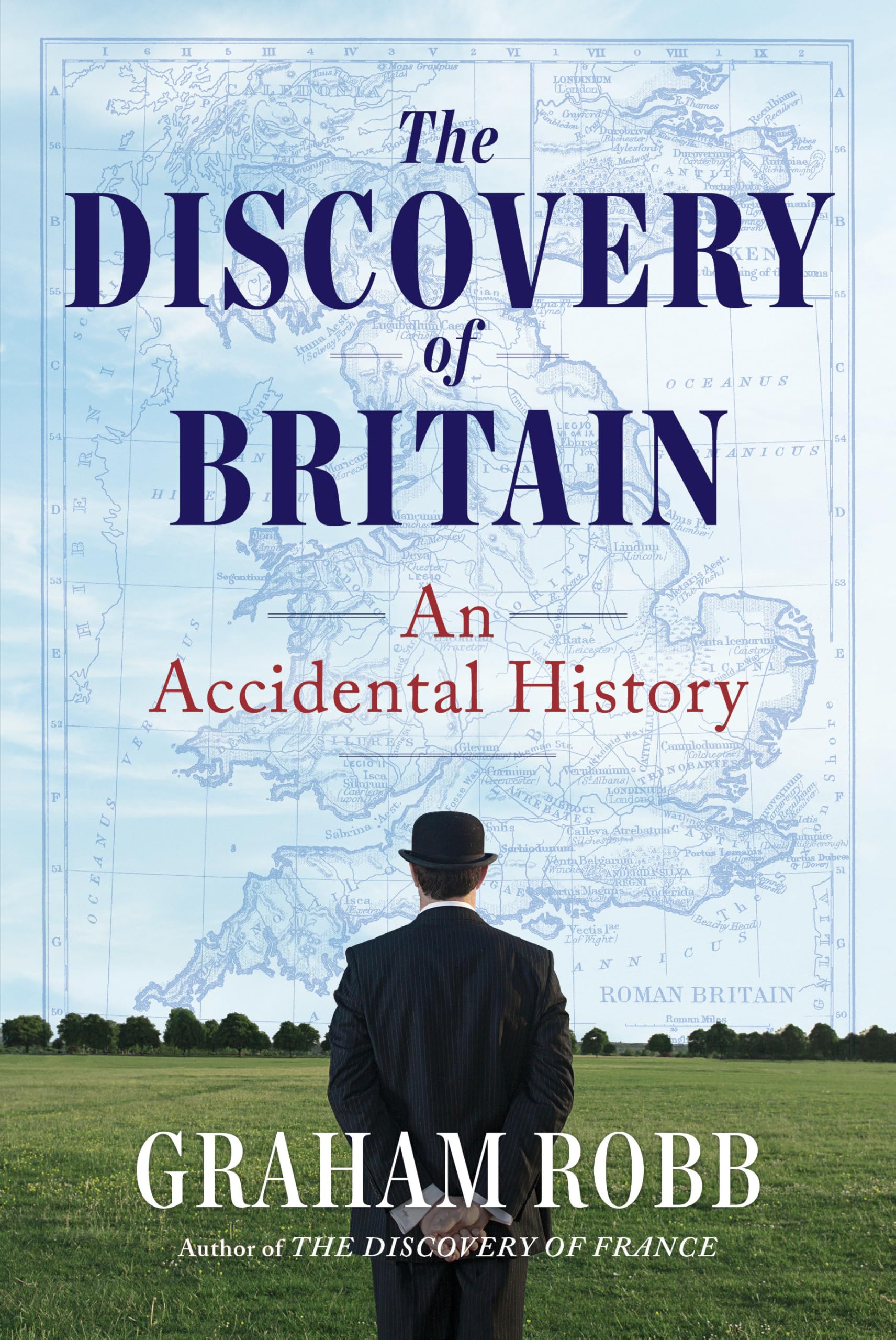
The Discovery of Britain: An Accidental History
4.2 | 10 ratings
Price: 31.48
Last update: 01-27-2026
Product details
- Publisher : W. W. Norton & Company
- Publication date : January 20, 2026
- Language : English
- Print length : 464 pages
- ISBN-10 : 1324074949
- ISBN-13 : 978-1324074946
- Item Weight : 1.3 pounds
- Dimensions : 6.3 x 1.5 x 9.3 inches
- Best Sellers Rank:#2,919 in Books (See Top 100 in Books)
- Historical Geography
- General Great Britain Travel Guides
- Travelogues & Travel Essays
- Customer Reviews:4.24.2 out of 5 stars(10)
Top reviews from the United States
- JCA Two-Wheeled Time Machine: Graham Robb's "The Discovery of Britain"Graham Robb cycled backwards through two thousand years of British history—metaphorically traversing those millennia to read time inscribed in the landscape. Rather than relying solely on narrative, the landscape itself reveals historical layers: an old hedge marks a pre-Norman boundary, while a parish edge follows an Iron Age road now hidden beneath modern tarmac. "The Discovery of Britain: An Accidental History" thus functions as a form of geographical archaeology with the author's bicycle serving as a "two-wheeled time machine" for interpreting temporal inscriptions in the land.
Robb argues that Britain is a palimpsest, where ancient landscape features and historical upheavals continue to exert a "subatomic force" on contemporary identity and politics. He asserts that "some historic upheavals were so violent that the wreckage is still reaching us today," a position he substantiates through three unconventional methods: cartographic reconstruction, genetic evidence, and physical ground-proofing conducted via extensive cycling expeditions. Consequently, the book challenges established narratives regarding Roman civilization, Saxon invasions, and the legendary status of King Arthur.
Robb's most significant finding concerns pre-Roman Britain. Utilizing Ptolemy's second-century coordinates, he modifies the standard grid to a 4:3 ratio informed by Druidic solstice bearings. This approach uncovers a sophisticated Iron Age mapping system whose precision was not equaled until the Renaissance. This evidence challenges the "colonialist conception" that the Romans introduced civilization to primitive Britons. Instead, it indicates indigenous expertise in cartography and road-building long before the Roman conquest, a position likely to generate debate among historians with more conventional perspectives on Celtic Britain.
Robb's analysis of King Arthur is similarly provocative. Employing his reconstructed atlas to locate battle sites mentioned in early Brittonic texts, he posits the existence of a historical second-century military leader who orchestrated a coordinated resistance across northern Britain. In this account, Arthur is presented as a historical figure rather than a product of medieval romance, though questions remain regarding whether Robb's geographical methodology offers adequate evidence to support such a definitive assertion.
Robb's ground-proofing methodology warrants particular consideration. He physically retraces ancient routes, employing his bicycle to corroborate historical texts and identify boundaries preserved in contemporary hedgerows, parish lines, and road patterns. This approach constitutes an unusual form of research, juxtaposing documentary sources with physical evidence. Simultaneously, the narrative is interwoven with autobiographical elements, including Robb's childhood in 1960s Worcestershire, his family's wartime experiences, and his education at Oxford. Far from diminishing the work, this autobiographical element often strengthens it, humanizing abstract historical patterns. When successful, as in his account of cycling through a 2018 hurricane and recognizing an Iron Age road network, the method yields genuine insight.
Robb imparts the book with significant contemporary relevance by interpreting the Norman Conquest as a persistent structural force rather than a discrete historical event. Citing studies that correlate Norman surnames with modern elite status and Oxbridge admission rates, Robb contends that Britain's class system operates as originally intended, rather than malfunctioning. This argument extends to his examination of land ownership—approximately half of England remains in the hands of the gentry and nobility—as well as education, where he identifies the persistence of "educational apartheid," and political access. The resulting implications are stark: social mobility remains limited, not due to failed reforms, but because institutions were deliberately structured to inhibit it.
The book's political analysis intensifies in its later chapters, as Robb draws connections between historical patterns and contemporary issues such as Brexit, "hostile environment" immigration policies, and what he terms historic levels of political "sleaze." His examination of the illegal 1945 deportations of Chinese merchant seamen from Liverpool and the subsequent Windrush scandal illustrates the longstanding nature of institutional secrecy and racialized policy. While the validity of linking Brexit to ancient tribal boundaries is open to debate, Robb's broader argument—that contemporary crises have historical antecedents and causes—remains compelling. He describes the modern House of Commons as a "Through-the-Looking-Glass chamber" characterized by pervasive mendacity, a perspective that some readers may regard as incisive political analysis and others as polemical rather than historical.
Robb deliberately eschews chronological structure with the book's organization, arguing that "no creature or nation lives life in chronological order." The narrative shifts from geological events dating back 300 million years to the COVID pandemic, and from Neolithic settlement patterns to the cancellation of the HS2 railway. This associative, geographically-based structure enables unexpected connections, such as linking the ancient geology of the Anglo-Scottish border to contemporary political identities. However, this approach can compromise coherence. Readers who prefer linear progression or comprehensive coverage may find the structure challenging, while those receptive to Robb's geographical logic may recognize that the structure itself advances the argument that history is characterized by persistence and layering rather than linear succession.
Robb's prose style is varied. At its most effective, he writes with precision and wit, characterizing Britain as a "sea-fearing" rather than "sea-faring" nation, remarking that "nostalgia is the Alzheimer's of history." He employs literary references, ranging from Tolkien to Milton. He explains complex topics—such as the transition from Old English to Middle English and the endurance of the shire system—with clarity. Nevertheless, the writing occasionally becomes overly detailed or argumentative, particularly when Robb challenges traditional historical narratives.
The book's speculative aspects are likely to polarize readers. Robb's cartographic reconstructions necessitate mathematical adjustments to ancient coordinates, his identification of Arthur depends on geographical pattern recognition, and his attribution of the shire system to the fifth century—significantly earlier than conventional accounts—relies on the observation that boundaries consistently disregard Roman roads. While these arguments are inventive, they depend on methodologies that some historians may consider insufficiently rigorous. Robb acknowledges this methodological tension indirectly, stating that "all history is wrong, including the histories which correct the erroneous histories," yet he maintains unwavering confidence in his own interpretations.
"The Discovery of Britain" is most effective as a critique of complacency. Robb contends that a genuine understanding of Britain necessitates moving beyond comforting national myths to confront a more intricate and frequently unsettling reality: advanced indigenous civilizations erased from historical memory, violent conquests with enduring effects on class structures, intentionally concealed institutional secrets, and contemporary political failures rooted in historical design rather than mere accident. Regardless of whether readers accept his specific assertions regarding pre-Roman science or Norman social physics, the overarching argument is compelling: the past remains present in Britain, manifesting physically in hedgerows and road networks, legally in land ownership, and socially in patterns of educational and occupational attainment.
"The Discovery of Britain" is an intentionally unsettling work. Robb doesn’t provide a reassuring synthesis or redemptive narrative. Instead, he depicts Britain as a nation where the remnants of history continually resurface, ancient upheavals shape contemporary realities, and the landscape itself testifies to truths that institutions and official histories often obscure. Readers looking for traditional historical accounts may find the book unsatisfying, while those willing to follow Robb's unconventional methods will encounter what may be the point: Britain's present problems are not accidents of policy but consequences of design, and the landscape itself holds the evidence.