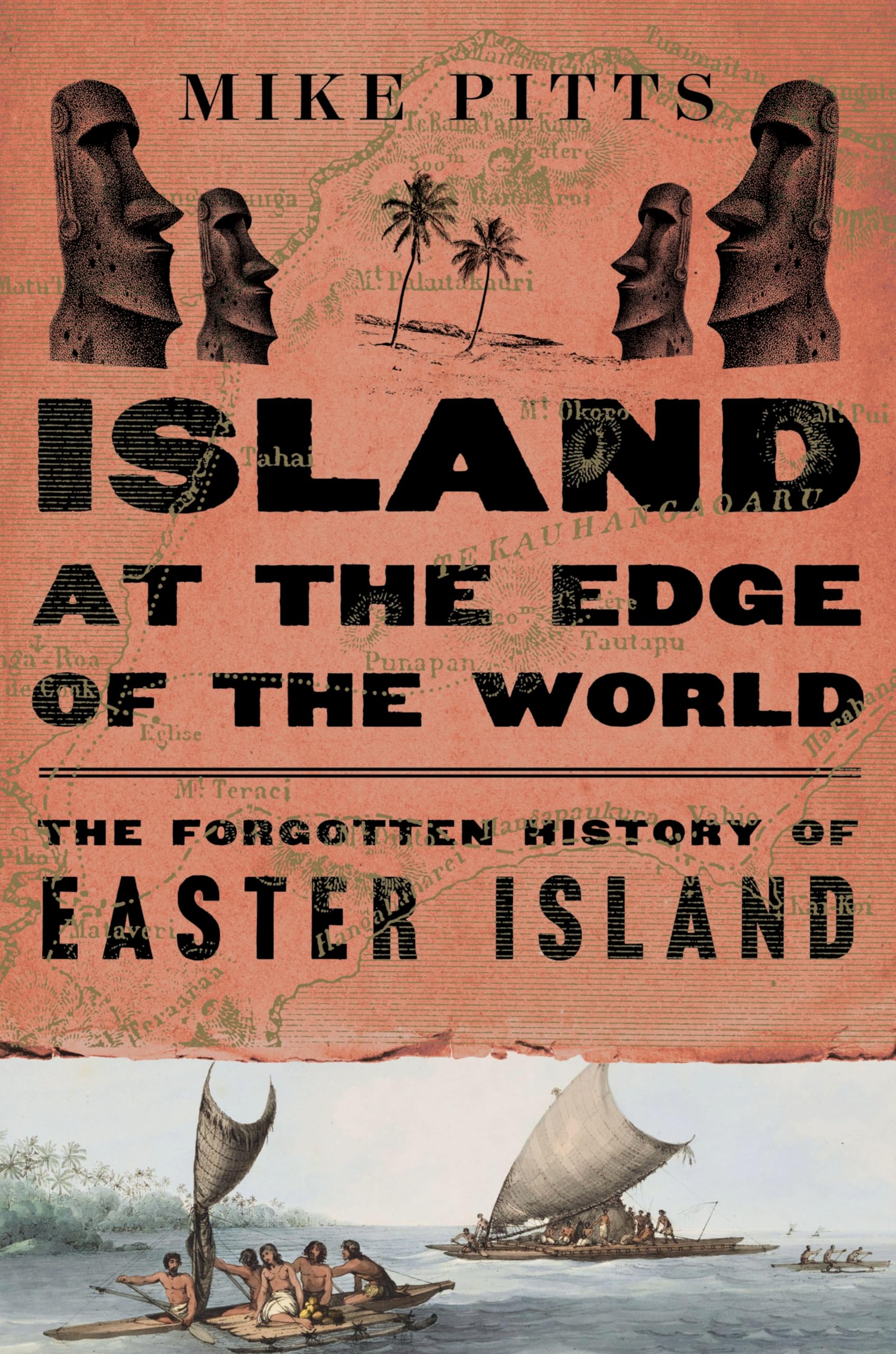
Island at the Edge of the World: The Forgotten History of Easter Island – A Provocative Archaeological Study of Colonial Lega
4.8 | 5 ratings
Price: 15.99
Last update: 02-02-2026
Product details
- ASIN : B0DMSYDG5D
- Publisher : Mariner Books
- Accessibility :
- Publication date : January 27, 2026
- Language : English
- File size : 29.4 MB
- Screen Reader : Supported
- Enhanced typesetting : Enabled
- X-Ray : Not Enabled
- Word Wise : Enabled
- Print length : 368 pages
- ISBN-13 : 978-0063344693
- Page Flip : Enabled
- Best Sellers Rank:#2,532 in Kindle Store (See Top 100 in Kindle Store)
- Archaeology (Kindle Store)
- Oceania History
- Chile Travel Guides
- Customer Reviews:4.74.7 out of 5 stars(4)
Top reviews from the United States
- JCDebunking Easter Island's FallI first encountered Easter Island in the 1994 film "Rapa Nui"—unsettled, intrigued, and certain the story was incomplete. Further reading only deepened my skepticism: I found environmental parables, racialized speculation, and assertions that seemed designed to confirm contemporary anxieties rather than illuminate the past. Mike Pitts’s "Island at the Edge of the World" is the book I needed then.
Pitts aims to dismantle what he terms the “ecocide narrative,” the enduring assertion that the Rapanui precipitated their own downfall through environmental mismanagement, deforesting the island to support a purportedly reckless statue-building cult, which allegedly led to warfare and cannibalism. While this narrative may function as a compelling allegory, it does not withstand historical scrutiny. Instead, Pitts reconstructs the history of a resilient Polynesian society that adapted resourcefully to extreme isolation, only to be devastated in the nineteenth century by slave raids, disease, and colonial dispossession.
The book’s structure mirrors its central argument. Pitts opens with the consequences of European contact, including slave raids, disease, and the establishment of a sheep ranch, before analyzing how the island was subsequently studied and misinterpreted. Only after this does he reconstruct ancient Rapanui society. This sequence is intentional: understanding the island’s past requires first recognizing the violence that destroyed it and the misinterpretations that followed. The collapse must be clearly understood before the society’s achievements can be accurately assessed.
The book’s primary innovation is its recovery of Katherine Routledge’s archival materials. Routledge arrived on Rapa Nui in 1914 with her husband Scoresby aboard their custom-built yacht, the "Mana," with the intention of conducting the island’s first systematic archaeological and ethnographic study. The unique value of her work lies in its timing: she interviewed elders who retained living memories of pre-collapse traditions. Routledge acquired the language, mapped the quarries, documented ceremonial sites, and recorded the meanings of the moai as understood by their creators. Following her subsequent mental breakdown, her research became dispersed across English archives, remaining uncatalogued and largely unexamined for decades. The absence of her voice allowed speculative theories, such as those involving ancient aliens and lost continents, to proliferate in place of rigorous archaeology.
Pitts devoted years to reconstructing Routledge’s fragmented notebooks and field records. The resulting narrative challenges nearly all assumptions of the prevailing popular account. Early European visitors—Roggeveen in 1722, the Spanish in 1770, and Cook in 1774—did not encounter a society in terminal decline. Instead, they observed ongoing ceremonies at standing statues, the cultivation of sophisticated gardens utilizing lithic mulch (volcanic rock that retained moisture and enriched soil), and a social structure organized under clan chiefs capable of formal diplomatic engagement. La Pérouse noted that the islanders tilled their fields “with a great deal of intelligence.” Such observations are inconsistent with the notion of societal collapse.
The true collapse of Rapa Nui society was abrupt and externally imposed. In 1862, Peruvian slave ships arrived and seized an estimated 1,500 individuals, including most leaders and ritual specialists who were custodians of cultural knowledge. International intervention eventually compelled Peru to repatriate some survivors, but they returned carrying smallpox and tuberculosis. The island’s population fell from approximately 5,000 to only 110 by 1877. This event constituted not a gradual decline, but demographic devastation. The remaining population was confined to Hanga Roa, enclosed by a wall, as their land was converted into a sheep ranch and their gardens were destroyed by grazing livestock.
The toppled moai, frequently cited as evidence of pre-contact civil conflict, actually fell during this period of upheaval. Their destruction was a symptom of societal devastation, not its cause.
Pitts adopts a deliberately polemical stance. He examines how the ecocide narrative has appealed to various audiences: environmental advocates have embraced it as a cautionary tale, while filmmakers have exploited its dramatic potential. The 1994 "Rapa Nui" film is a particular source of frustration for Pitts, as it transformed academic conjecture into cinematic certainty and, in the process, damaged archaeological sites and left fiberglass “statues” scattered across the island. The film crew’s complaints about food shortages, which were a direct result of their own consumption, serve as a poignant example for Pitts, who highlights the irony that Hollywood enacted the very resource depletion it erroneously attributed to the Rapanui.
Pitts grounds his arguments in DNA analysis, paleobotanical research, experimental archaeology, and meticulous examination of early European accounts. When asserting that the moai were transported upright rather than rolled, or that the rongorongo script likely originated after European contact, he acknowledges areas of uncertainty without resorting to false equivalence. Pitts maintains that not all interpretations hold equal merit and rejects theories rooted in racial skepticism or unsupported environmental moralizing.
The book is not without limitations. Certain reconstructions rely on inference, and Pitts at times dismisses oral traditions that contradict material evidence, a tension he acknowledges but does not entirely resolve. However, these challenges are intrinsic to authentic historical revision, rather than the uncritical repetition of established narratives.
Pitts ultimately restores agency to the Rapanui. Their history has often been recast as a cautionary tale, distorted to reflect Western anxieties about environmental limits and societal collapse. The true narrative, characterized by resilience and disrupted by colonial violence, is less convenient but far more instructive. "Island at the Edge of the World" does not cater to readers seeking mystery or allegory; rather, it challenges those willing to confront the reality that historical truth is frequently more complex and unsettling than the parables we construct.
This review is of an advance reader’s edition provided by NetGalley and Mariner Books.