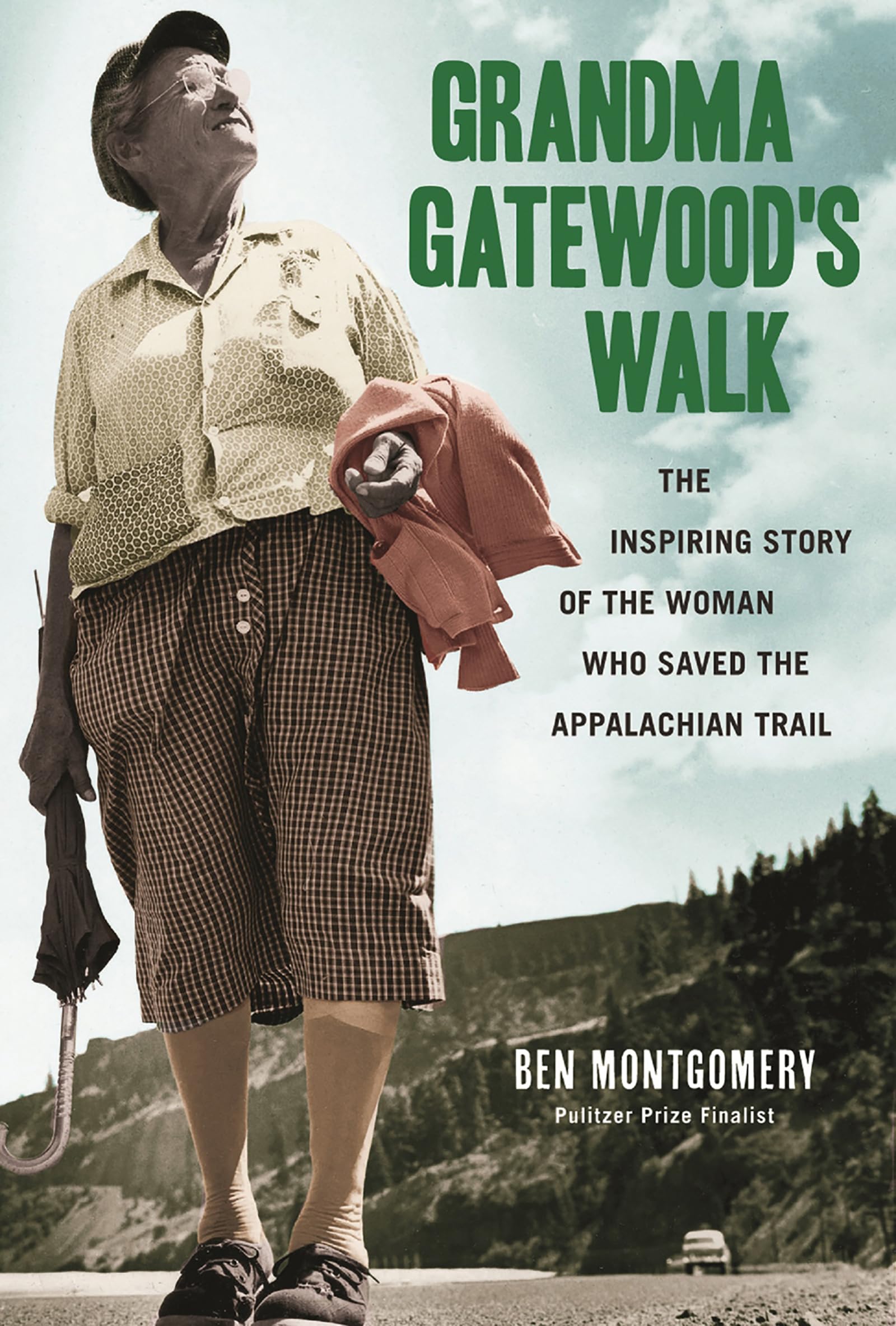
Grandma Gatewood's Walk: The Inspiring Story of the Woman Who Saved the Appalachian Trail
4.6 | 10,623 ratings
Price: 11.13
Last update: 02-19-2026
Product details
- ASIN : B00IQY2Q0O
- Publisher : Chicago Review Press
- Accessibility :
- Publication date : April 1, 2014
- Language : English
- File size : 4.3 MB
- Screen Reader : Supported
- Enhanced typesetting : Enabled
- X-Ray : Enabled
- Word Wise : Enabled
- Print length : 292 pages
- ISBN-13 : 978-1613747216
- Page Flip : Enabled
- Best Sellers Rank:#706 in Kindle Store (See Top 100 in Kindle Store)
- Travel (Kindle Store)
- Hiking & Walking Travel
- Hiking & Camping Excursion Guides (Books)
- Customer Reviews:4.64.6 out of 5 stars(10,623)
Top reviews from the United States
- AlfrethaExcellent read, brave and determined womanHaving hiked part of the AT in the late 1960s, appreciating the shelters every 20 miles along the section we went, it took an incredible woman to walk the entire AT alone before it was maintained so well. The stories of her life as well as the incredible "hikes" she took made this a book hard to put down. Recommend to anyone to loves to hike.
- Clyde S. DaleWalking Through it AllIn Ben Montgomery’s eye-opening profile, Grandma Gatewood’s Walk: The Inspiring Story of the Woman Who Saved the Appalachian Trail, readers encounter the real life folk heroin Emma Gatewood. On the trail, her story is legend; and it takes on such proportions for a plethora of reasons, some of which have nothing to do with hiking. She gave birth to eleven children and somehow managed to find the time and energy to help her husband run a farm—several, in fact. She found time to read the classics. She wrote poetry and kept a detailed journal. She hiked. She spent lots of time in the woods. She knew all the local flora and fauna, what was edible, what was medicine, and what to avoid. She endured the tragedy of a violently abusive marriage to one P.C. Gatewood, a “relationship” in which he consistently physically assaulted and raped her; on at least one occasion he broke one of her ribs. She was a fighter, a survivor, and a trailblazer in every sense of those words. And yes, she was the first woman to thru-hike the Appalachian Trail: not once, not twice, but three times—also a first. Emma Gatewood, perhaps because of that adversity, those tragedies and hardships, would turn her story into one of a triumph of the human spirit by doing nothing more than putting one foot in front of the other: more than five million times over the course of nearly five months.

On 3 May, 1955, Emma Gatewood, sixty seven year old mother of eleven, stood on Mt. Oglethorpe in Georgia, which was at that time the southern terminus of the Appalachian Trail, and prepared to take her first steps toward Mt. Katahdin in Baxter State Park in the state of Maine more than 2,000 miles away. She would do this in a single push; she would thru-hike the Appalachian Trail. The average hiker who completes this feat takes from five to seven months. Over this time, hikers brave the elements, cuts, scrapes, bruises, wild animals, danger to life and limb through falling or injury, hunger, disease, and any number of other dangers. Thus, thru-hikers are also generally well prepared, even if they carry as little as possible to cut back on weight over very long hikes. From a tent, rain gear, bug spray and sunscreen, food, water filters and cooking materials, extra-socks and clothing to perhaps even a second pair of shoes or boots, most hikers will carry everything they need in an ultra-light, well designed pack that, on average, weighs somewhere between thirty and fifty pounds. (The recommendation is that a pack shouldn’t weigh more than 20% of a hiker’s body weight.) On that day in 1955, Emma Gatewood had with her a shower curtain for a shelter, a tasteful dress in case she needed to look nice, some mints, and other various and sundry items in a pack she had sewn out of denim. She carried this pack, weighing twelve pounds, slung over her shoulder. It’s at this point in Ben Montgomery’s profile that readers come to understand that they have never done anything this hardcore in their life.

At 268 pages, Montgomery’s volume is by no means slim; it is, however, a page turner. A lot also has to do with the narrative structure Montgomery deploys. Rather than working from birth to death and detailing the events of a life chronologically, Montgomery breaks the text up into parallel thematic elements. Over the course of the essay he pairs the trail narrative with that of Gatewood’s personal life, or the background of social and political history. Some reviewers have criticized this narrative structure, suggesting that some of the historical, social and political commentary distracts from Gatewood’s story. However, such criticism fails to fully grasp Montgomery’s purpose. By organizing the text in this manner, Montgomery achieves the feat of helping (careful) readers to understand just how rebellious, how revolutionary, Emma Gatewood’s walk really was. In this light, hiking becomes not an activity of leisure in which one seeks health and wellness —though in some sense it is that—it instead becomes an act of defiance. Additionally, it shows that Emma’s life, very nearly from beginning to end, was simultaneously full of both beauty and danger.
Both the title and organization of the chapter “Rhododendron and Rattlesnakes” juxtapose elegant, delicate beauty with life-threatening danger:
South of town, in a cabin on Sugar Creek, Emma Gatewood learned she was pregnant with her first child not long before her new husband struck her for the first time. He smacked her with an open hand, and the sharp sting of his palm on her cheek stunned her, frightened her. (33-34)
In our imaginations we are with Emma Gatewood on “Sugar Creek”, a meandering stream, perhaps hard by some lazy acreage as she caresses her swelling belly, as she thinks about the future, as she hopes, as she dreams the dreams of a life yet lived. Then we feel the “sting” of a hand on her face as we too are “stunned” by a “strike” seemingly out of the blue. Surely, Montgomery’s word choice is no accident; he’s painting P.C. Gatewood as a viper. Rhododenra thrive in harsh environments, sometimes under severe conditions such as those often found on the AT, or in this case, at home. Furthermore, the use of the singular in "rhododendron" suggests the singularity of Gatewood's person, while rattlesnakes suggests the plurality of her trials. It is this type of narrative brilliance that allows Ben Montgomery to tether Emma Gatewood’s personal life to the trail narrative. In so doing, he shows how factual events in a life become a metaphor: “She was surrounded by unfamiliar territory, alone in a foreign place, full of curiosity and also dread and fear of the unknown” (33). Despite the fact that Montgomery, here, is talking about a specific experience of Gatewood’s journey on the trail, it applies to her personal life as well. And that’s the point.
In addition to the supplying details from Emma Gatewood’s personal life, Montgomery provides his readers with a sense of the social and political setting in the 1950s, further highlighting the uniqueness, perhaps even the rebelliousness of her decision and actions. It was an incredibly conservative era in American history when a woman’s place was in the home. It was the era of the “Sunday drive”. It was a time when people were supposed to be moving to the suburbs and enjoying the peace and comfort of the good life from behind a white picket fence. It was also a politically charged and revolutionary era. McCarthyism was rampant, the cold war was in full swing, the U.S. had just tested an H-bomb on Bikini atoll, desegregation was at the center of social and political issues, and we must keep in mind that the mid-1950s was the nascence of the counter-cultural movement that would later explode and culminate in Woodstock. This is the same decade (the 50s) that Kerouac published The Dharma Bums and On the Road. This is the same decade in which climbers such as Royal Robbins, Steve Roper and Yvon Chouinard would seek an alternative to the conservatism being espoused by society in general. As young men they eschewed the norm and headed to Yosemite, living as “dirtbags”. They would climb and define a new, alternative ethic for how to live one’s life. It is during all this that Emma Gatewood chose to walk. Given the backdrop of conservative America, her act was one of revolution.

As to why “Grandma Gatewood” did all this? That remains a mystery. She achieved national celebrity during her hike. Reporters tracked her down, followed and documented her journey on the trail; Sports Illustrated wrote a profile of the grandmother from Ohio. All along, whatever they sought to know or whatever questions they asked, there was one that they all had in common: “Why are you doing this?” Gatewood gave a number of responses over the years, but never seemed to provide a full, satisfactory answer. As Montgomery has it,
Emma was coy when people asked why, at her age, she had decided to strike out on the long trail. As America’s attention turned more toward Emma in her final days on the A.T., as newspaper reporters ramped up their dispatches to update the public on her condition and whereabouts, she offered an assortment of reason about why she was hiking. The kids were finally out of the house. She heard that no woman had yet thru-hiked in one direction. She liked nature. She thought it would be a lark.
I want to see what’s on the other side of the hill, then what’s beyond that. (160)
Outside of some brief speculation, entertaining any number of possibilities as to why Emma Gatewood would do this, Montgomery concludes that the best answer to this question came from Emma herself, and not from those attempting to interpret the various answers she provided over the years. Montgomery believes that the simple reason, in Emma’s own words was, “Because I wanted to” (259). Outside of the epilogue and acknowledgements, here the book ends. It is most fitting that Montgomery ends it with Emma’s words, and not his.
In my experience a good many members of the outdoors community find their outlet in out of doors activities such as climbing, hiking, kayaking, camping, fishing, etc. It is also my experience, or at least my perception, that the percentage of people in this community who are victims of trauma, battle mental illness, or experience moderate to severe anxiety or stress exceeds that of the national average. (I may have to write an essay on this.) Emma Gatewood seems to be no exception. Given her experience it may be easy for audiences to think that she was running from something, or perhaps running toward something. Perhaps that’s true. And while Montgomery is satisfied with Emma Gatewood’s “Because I wanted to”, he also admits that her numerous answers seem “as though she wanted people to seek out their own conclusions” (160). I like to think that she was walking through it. No one can run that long or that far. Whatever we run from will eventually catch us. We can, however, out-endure it. Whatever “it” is. When we walk, we walk with our problems, not away from them; we acknowledge their existence. In acknowledging their existence we provide ourselves the opportunity for a solution. Walking provides the focus and perspective necessary to discover the solution. The road may be long, with many a-winding turn, but only by setting out and putting one foot in front of the other, again, and again, and again, will we get there. - The archaeologistNice readThe book is good because the writing is fine. That said it could have used better editing as it is a bit repetitive. But the author’s writing talent make this rather thin story worth reading. There is more of a sociological point tone made with the story, but the author is more interested in Gatewood as a human than as a woman. He missed a chance to understand the structural origins of feminism which he seems to fear. A little more research on the social context of the family would have helped make sense of Gatewood’s passion. He mentions many photographs of Gatewood that are not in the book and photos of some of the superb vistas would have been nice. But because he thinks journalism is “just the facts” the story isn’t about anything. Without more context it isn’t about Gatewood, without vistas and real ecology it isn’t about the trail, without discussion of use and access it’s not about preservation. I understand he didn’t want to tell a maudlin story of personal triumph, but the facts do not speak for themselves, there is a reason the author chose some facts and not others, believed some stories and not others. Ignoring his own frame (pretending there isn’t one) leaves the story shallow.
- K. JohnsonTouching story about a gentle giant!I had never heard of Grandma Gatewood, and living far closer to the John Muir Trail than the Appalachian Trail, I knew little about the AT itself. This book was actually an Amazon "suggestion" and I am soooo glad I heeded that suggestion!
First, this is not a "how to" hike book on the Appalachian Trail. There are tons of those out there already. This is the true story of a determined, tough, unassuming, 67 year old grandmother, who on a lark, decided to thru-hike the AT. In doing so, and unbeknownst to her at the time, she became the first woman to do it solo, and garnered a level of attention that ensured that improvements were made to the trail and brought the AT into the American consciousness at a time when few people knew it existed.
The author, very much like the woman herself, is unassuming in his storytelling. He refrains from melodrama and dramatic "enhancements", but tells the story gently.....quietly..... just like Grandma Gatewood would. His reverence for her is evident, and through detailed research into her journals, and interviewing her family, we get a glimpse of an incredibly remarkable and inspiring woman. Weaving back and forth mainly between her first thru-hike of the AT, (and yes, she did it several times) and her tough, troubled marriage to an abusive and demanding husband, we see a woman who despite severe obstacles, and a troubled past, decided to do an incredibly difficult thru-hike with minimal equipment, but a lot of determination, and did so without once feeling sorry for herself or relying on tens of thousands of dollars of the latest ultralight equipment. She puts most Americans to shame!
While there are adequate details about hiking the AT, the real story is Grandma Gatewood herself. She was an incredibly simple, self-sufficient and determined woman, made famous by the simple act of walking, and even if you have no interest in hiking whatsoever, you will find this to be an uplifting and engrossing story. As an interesting side note - I am familiar with the "Gatewood Cape", yet had no idea it was named after her! - runoftenInspiring and amazing!I've read many books of people's hike of the AT as well as many other trails. This tops them all! It's hard to believe that in spite of the abuse Grandma Gatewood suffered, she went on to hike the AT not just once but several times. She was one of a kind. I really enjoyed this book.