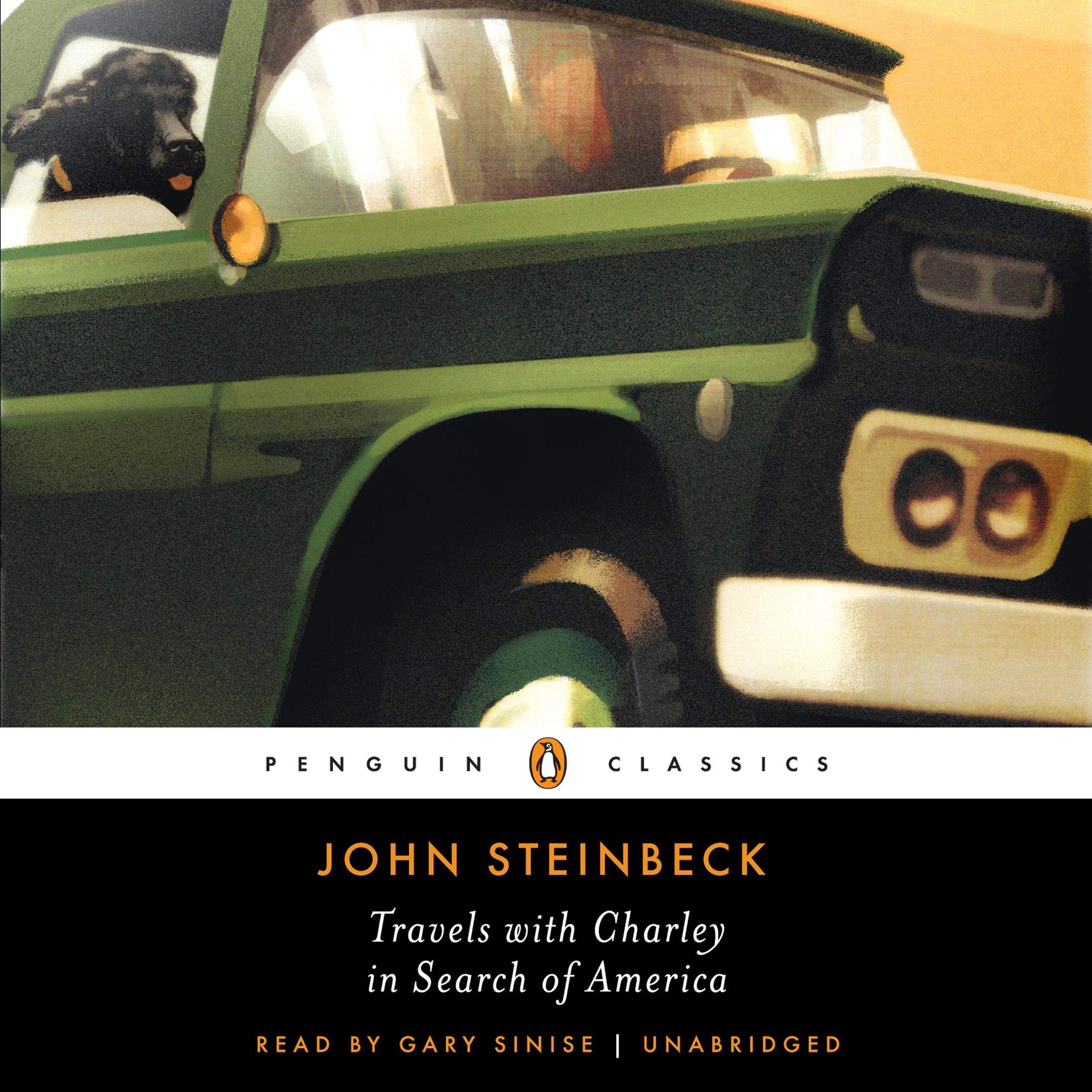
Travels with Charley in Search of America
4.5 | 9,030 ratings
Price: 13.78
Last update: 04-12-2026
Top reviews from the United States
- Brian D. FitzpatrickCourage,Curiousity,and a Loving and loyal wifeSteinbeck at his most brilliant.What a marvellous and delightful read.
Charley,his travelling buddy,a french poodle,reminded me alot of E.B. White's affection for the anthropomorphic qualities of animals.
The kindness of Stuart Little,Charlotte,and poor old Wilbur!Charley is a nice fellow.I won't spoil the book for you with any details,but one.Steibeck was getting on,feeling old,and decided to travel the US in his re-outfitted camper with his pal Charley.Of course,with his dear wife's consent.
I consider this to be one of the great passages in modern fiction.
THE GIST OF LIFE:
"...In long range planning for a trip,I think there is a private conviction that it won't happen.As the day approached,my warm bed and comfortable house grew increasingly desirable and my dear wife incalculably precious.To give these up for 3 months for the terrors of the uncomfortable and unknown seemed crazy.I didn't want to go.Something had to happen to forbid my going,but it didn't.I could get sick,of course,but that was one of my main but secrets reasons for going at all.During the previous winter I had become rather seriously ill with one of those carefully named difficulties which are the whispers of approaching age.When I came out of it I recieved the usual lecture about slowing up,losing wieght,limiting the cholesteral intake.It happens to many men,and I think doctors have memorized the litany.It had happened to so many of my friends.The lecture ends "Slow down.You're not as young as you once where".And I had seen so many begin to pack their lives in cotton wool,smother their impulses,hood their passions,and gradually retire from their manhood into a kind of spiritual and physical semi-invalidism.In this they are encouraged by wives and relatives,and it's such a sweet trap.Who doesn't like to be the center for concern?A kind of second childhood falls on so many men.They trade their violence for the promise for a small increase of life span.In effect,the head of house becomes the youngest child.And I have searched myself for this possibility with a kind of horror.For I have alway lived violently,drunk hugely,eaten too much,or not at all,slept around the clock or missed two nights of sleeping,worked too long and hard in glory,or slobbed for a time in utter laziness.I've lifted,chopped,climbed,made love with joy,and taken my hangovers as a consequence,not a punishment.I did not want to surrender fierceness for a small gain in yardage.My wife married a man;I saw no reason why should inherit a baby.I knew that ten or twelve thousand miles driving a truck,alone and unattended,over every kind of road would be hard work,but to me it represented the antidote for the poison of the professional sick man.And in my own life I am not willing to trade quality for quantity.If this projected journey should prove too much than it was time to go anyway.I see too many men delay their exits with a sickly,slow reluctance to leave the stage.It's bad theatre,as well as bad living.I am very fortunate of having a wife who likes being a women,which means she likes men,not elderly babies.Although this last foundation for the trip was never discussed,I am sure she understood it..."
(Penquin Books-1962 from 'travels with charley' pgs 19-20)
Enjoy folks.Health and Happiness - J. BosiljevacLoved itI loved this book. I don't know why Steinbeck's gentle prose and sharp wit surprised me so much--perhaps because The Grapes of Wrath and Of Mice and Men, my other Steinbeck reads, were more serious. But from the first few chapters it is obvious that Steinbeck is not only a masterful writer but also an incredibly likable person.
This book is about a road trip Steinbeck took in 1960 with the stated goal of finding out what the true America is like. Upon further research, I found that Steinbeck had a heart condition and knew he would not live much longer. Thus, as his son surmised, the real reason of the trip was to give Steinbeck one long, last contemplative look at the American that permeated his classic novels.
"In Spanish, there is a word...vacilando. If one is vacailando, he is going somewhere but doesn't greatly care whether or not he gets there, although he has direction." That is the spirit with which Steinbeck sets off with Charley, his standard poodle. His camper is named Rocinante after Don Quijote's horse, an acknowledgement of his quixotic quest.
He sets off from New York and circles the country counterclockwise and literally observing it from all angles, one of America's greatest writers describing his grand subject in short scenes and insightful observations.
Although Steinbeck laments the disappearance of regional dialects and the growing homogeneity of the country, America is still a collection of vastly different cultures. A testament to Steinbeck's writing is that he is able to capture a cross-section of the country, good and bad, big themes and personal moments, in what is a relatively slim book.
He is critical of politics ("I find out of long experience that I admire all nations but hate all governments."), sometimes disillusioned by what he sees as the loss of American culture ("We have exchanged corpulence for starvation, and either one will kill us."), and wary of progress:
"American cities are like badger holes, ringed with trash--all of them--surrounded by the piles of wrecked and rusting automobiles, and almost smothered with rubbish."
But his faith in our goodness is bolstered time and again by personal encounters with folks at roadside campsites, lakes and veterinary offices. He frequently invites strangers to his camper to share a whisky or coffee, picks up hitchhikers to pick their brains, and has amusing encounters with a cast of characters that might populate a modern Canterbury Tales.
"I can only suspect that the lonely man peoples his driving dreams with friends, that the loveless man surrounds himself with lovely loving women, and that children climb through the dreaming of the childless driver." Steinbeck has Charley, the perfect companion, sometimes observing in bemusement the mysteries of human civilization, sometimes disinterested, sometimes engaging Steinbeck in fully-rendered conversations as 10,000 miles unfold under them.
"One goes, not so much to see but to tell afterward," Steinbeck reflects on the American traveler. What Steinbeck tells here is the story of who we are, an invaluable portrait that captures our complicated, idiosyncratic character, as true today as it was fifty years ago. Charley's conclusion, after much experience, is less nuanced: "I've seen...a quickly vanishing look of amazed contempt, and I am convinced that basically dogs think humans are nuts."