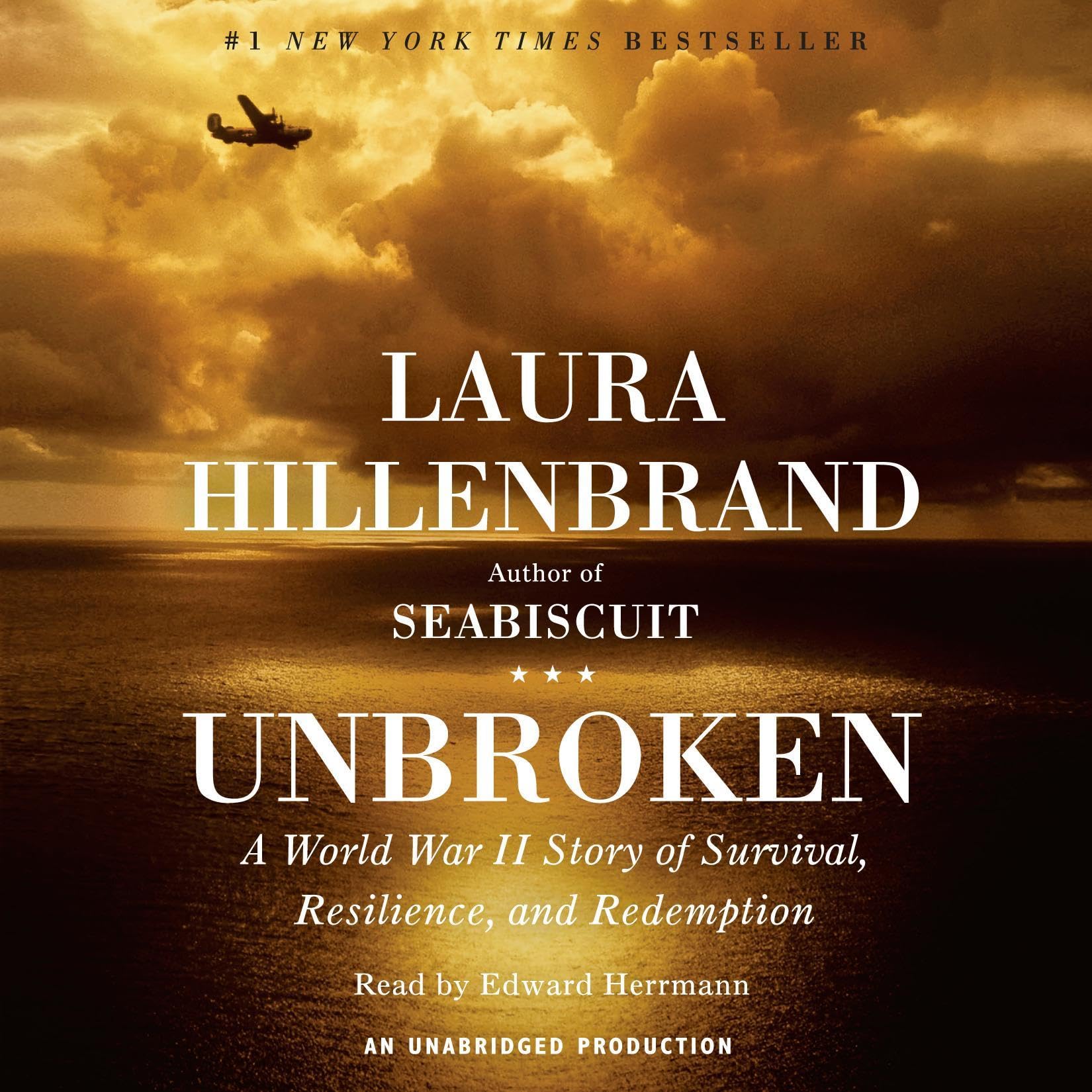
Unbroken: A World War II Story of Survival, Resilience, and Redemption
4.7 | 77,166 ratings
Price: 17.72
Last update: 04-18-2026
Top reviews from the United States
- Claudia MoscoviciUnbroken: Forgive but never forgetThere is a powerful phrase among those sympathetic to Holocaust victims and survivors: Never again! This phrase has two meanings: in one sense, it’s particular to the sufferings of the Jewish people (never again allow another Holocaust against the Jews). In another sense, it expresses a universal message for all humanity: Let’s never again allow another genocide based upon discrimination and hatred of any group of people. I interpret the phrase “Never again!” in the second, broader sense, which I believe is the most meaningful. Although the Holocaust was certainly about the massacre of Jews as Jews, any such genocide against any group of people is ethically wrong. For this reason, we should do whatever we can, as a human race, not to allow this to happen to anyone ever again. In this second sense of the phrase “Never again!”, I believe that the incarceration, starvation, torture and killings of American prisoners of war during WWII by the Japanese belongs to the history of the Holocaust.
Remarkably, American prisoners of war captured by the Nazis fared much better than those captured by the Japanese. The Nazis, who killed ten million innocent people in concentration camps and via shooting squads throughout Europe, were rather careful with non-Jewish Allied prisoners of war. Generally speaking, Allied POW’s lived in much better conditions than Jewish, Polish, Russian and Ukranian prisoners and had a much better chance of survival.
By way of contrast, American POW’s were in extreme danger when captured by the Japanese. They were subjected to similar mistreatment and conditions that Jewish prisoners had to endure at the hands of the Nazis: starvation, filth, disease, physical and psychological torture, slave labor and death. Of the 132,000 POW’s from the U.S., Great Britain, New Zealand, Australia and Holland forced into concentration and labor camps in Japan, more than one quarter of them—and about forty percent of the Americans—died in captivity. By way of contrast, only one percent of American POW’s held by the Nazis died in captivity. (see Unbroken, Laura Hillenbrand, New York: Random House, 2010, 314-315).
Although the Japanese didn’t have crematoria, similarly to the Nazis against the Jews, they adopted a “kill all” policy towards American POW’s during WWII. The Japanese policies were inherently racist. Much like the Nazi vision of a superior Aryan race, the Japanese policy was also informed by racial hatred, xenophobia and a sense of supremacy not only vis-à-vis the Americans, but also towards their Chinese, Koreans and European captives. Hence there are striking similarities between the racist outlook and behavior of the Japanese under the Prime Minister Hideki Tojo and that of the Germans under Adolf Hitler, his ally in war.
It is therefore not surprising that the remarkable memoir of resiliance and survival, Unbroken, a New York Times best seller in nonfiction and soon to be made into a major motion picture directed by Angelina Jolie, reads like a Holocaust memoir. Beautifully narrated by Laura Hillenbrand, Unbroken tells the moving life story of Louis Zamperini, a young soldier and star runner of the Berlin Olympics, who defies all odds in his struggle to survive war and captivity. This true story is so incredible that it reads like a Holywood script.
On May 1943, young Louis Zamperini’s plane crashes into the Pacific Ocean. The are only three survivers: Louis and two of his friends, who are compelled by misfortune to embark on an Odyssean voyage across the world. They’re stranded on a raft without food or water, drifting for thousands of miles, constantly threatened by bad weather conditions and assailed by sharks. They catch fish using bird meat as bait and collect rain water to stay alive. They patch up the raft when it is pierced by bullets and fight off sharks using their bare hands. Weakened by starvation, thirst, exhaustion and depression, one of them, Francis McNamara (Mac), gives up the fight for survival and perishes before reaching land. The other two, Louis Zamperini and Russell Allen Phillips (Phil), brave a typhoon and make it to an island. The most difficult part of their journey, however, comes not from natural threats but from attacks by fellow human beings.
They young men are captured by the Japanese, incarcerated, interrogated, then sent to concentration camps for POW’s. Louis is first sent to Ofuna, then to Naoetsu. In those camps, the conditions are inhumane. The goal of their captors, as for the Nazis, is total human degradation. Louis recalls two particularly sadistic guards who got a sexual thrill out of beating and torturing prisoners: Sueharu Kitamura, known as “the Quack”, who beat Louis’s friend, the brilliant Bill Harris, to unconsciousness, and Corporal Mutsuhiro Watanabe, dubbed “the Bird,” a vicious psychopath whom prisoners dreaded the most. “The Bird” particularly enjoyed tormenting Louis, the star American athlete. Alternating between savage beatings and fake shows of compassion, this monster became the bane of Louis’s existence, haunting him years after he was freed from captivity.
Much of Louis Zamperini’s post-traumatic stress disorder after liberation takes the form of nightmares in which he envisions strangling his former tormentor. This doesn’t relieve his pain, however. As the narrator wisely states, “The paradox of vengefulness is that it makes men dependent upon those who have harmed them, believing that their release from pain will come only when they make their tormentors suffer. In seeking the Bird’s death to free himself, Louie had chained himself, once again, to his tyrant” (Unbroken, 366). Though welcomed as a hero back home, Louis can’t escape the trauma of his war experiences. He drowns his bitter memories with alcoholism and sinks into a deep depression. Religion, along with his supportive and loving family, helps him overcome this last challenge. Louis’s greatest strength, however, stems from his own internal resilience: namely, from the capacity forgive his tormentors without forgetting his painful past. In fact, one of the most compelling messages of this incredible story is let go of the pain, so you can move on, but not of the memory. “Never again!” means, in part, forgive the enemy but never forget the experience, so it can offer wisdom to future generations.
Claudia Moscovici, Literature Salon - Jerry PooleDidn't think I would enjoy this bookFirst off, I did not think I would enjoy this book. I do not like war books, I do not like pain and suffering. That is about 99% of this book. I enjoy books such as The Mitford Series, Harry Potter, southern humorous books. I really like books that are well written and make you smile. So why did I read this one? I am going to work on a project where we record the histories of war veterans to be archived. We will interview them and record their accounts and experiences. We have a few World War II veterans living in our community, and I wanted to read up on my WWII history in order to know a little more about it than what I received in high school and college. The reviews on this book were very high, so I ordered it on my Kindle, and began reading, not expecting to enjoy it at all, and a little bit hesitant.
First off, I was quite surprised that I read it and actually enjoyed reading it. I also learned much more about WWII than I would have ever learned from a text book. The author used the facts that she had, and documented where her facts came from. This information was not boring either. She worked it into the story so that you knew what was going on during the war in Japan, at the same time "x" was going on on the other side of the world. You also would think that a person would give up long before Louie did, but he kept holding on, just like I kept holding on reading this book...you wanted to see if he would get out of the hell he was in and into a better place. Each time, it just kept getting worse. But, this still was not "hard" to read, because little bits of hope would filter in and keep you going...just like it kept Louie going. Louie is a remarkable man. I am sure there are many other remarkable men. My uncle survived the Bataan Death March, so he too had the drive that Louie had to survive, but Louie had kept every bit of documentation of his life and experience, so the author was able to use his photos, letters, etc to create this account of his life.
I started to give this a 4 star review...because I still do not like the subject matter, nor the abuse, the loss of so many lives...so the 4 star would be for the actual topic...the war with Japan. But that's not the books fault. The book is a 5 star book, so I went ahead and gave it a 5 star rating.
If you would like to read a good book, but aren't the history/war/torture type of reader...please don't let the subject matter of this book stop you. It is not presented in a way that makes it hard to read. On the contrary, it kept me reading. I know my review is lame. But I struggled with how to review this book, and I decided not to worry about how I "described it" and to just write my thoughts. I didn't want to put details in, because it was the details that kept me turning the pages, so I will leave them to you to discover. It's a book you will be proud to say "I read that book" and it will give you an insight to our veterans and what they endured. It also helps me to understand how bitter my uncle was whenever he would encounter an Asian from 'any' country...it didn't matter that they weren't Japanese...he couldn't be near them. I never understood that, but after reading how they were treated, now I understand.
I will probably purchase the hardcover edition of this book, so that I can have my kids read it and to have on my shelf for others to read, borrow, etc. I enjoy reading my Kindle, but some books deserve to be present on your shelf. This one does.