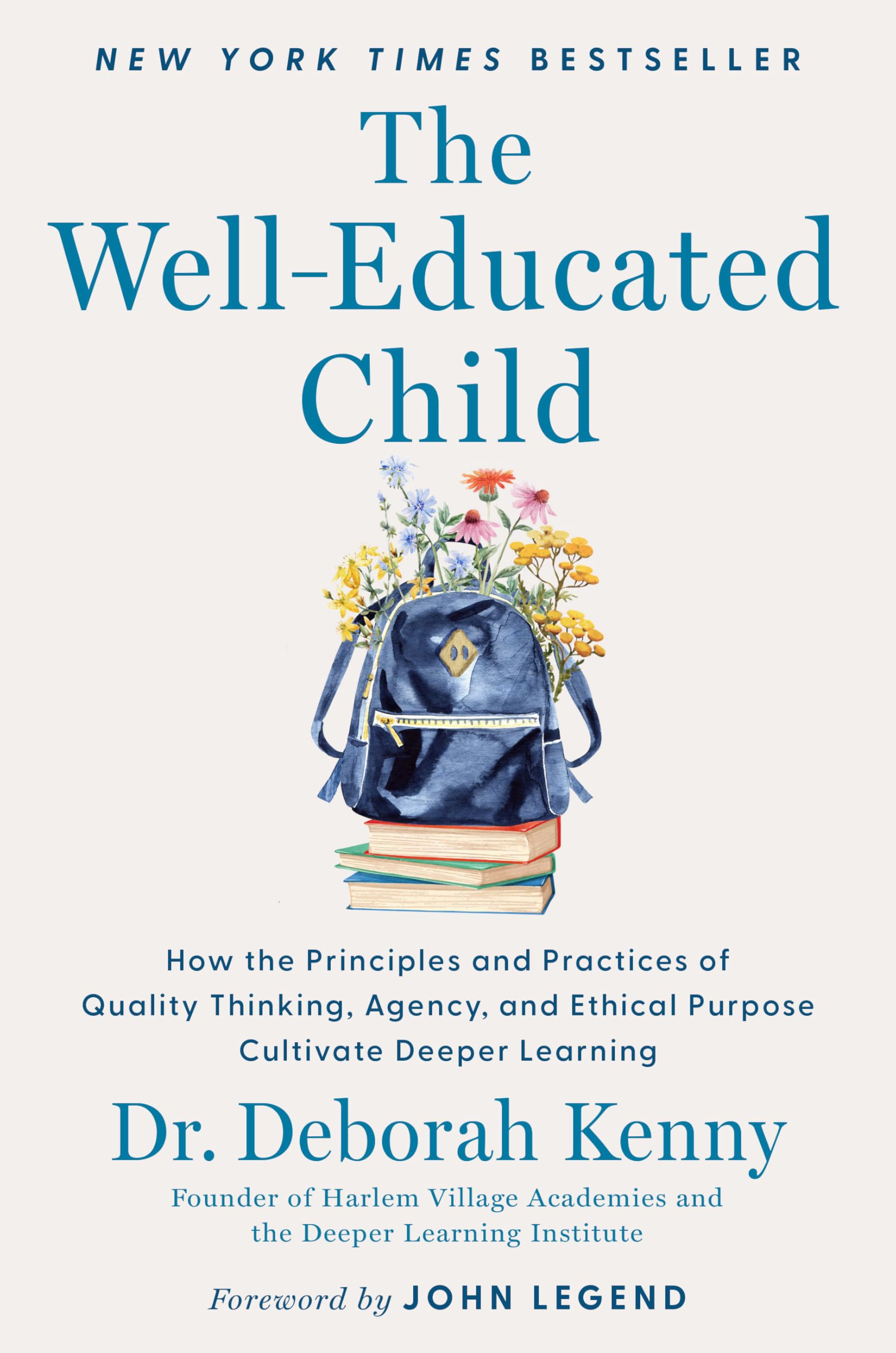
The Well-Educated Child: How the Principles and Practices of Quality Thinking, Agency, and Ethical Purpose Cultivate Deeper L
4.8 | 39 ratings
Price: 26.1
Last update: 05-16-2026
Product details
- Publisher : Get Lifted Books
- Publication date : April 21, 2026
- Language : English
- Print length : 192 pages
- ISBN-10 : 1638933324
- ISBN-13 : 978-1638933328
- Item Weight : 11.2 ounces
- Dimensions : 5.75 x 0.76 x 8.63 inches
- Best Sellers Rank:#47 in Books (See Top 100 in Books)
- Curricula (Books)
- Education Reform & Policy
- Education Workbooks (Books)
- Customer Reviews:5.05.0 out of 5 stars(8)
Top reviews from the United States
- David QuinnThinking Is the Work: A Review of The Well-Educated ChildThere’s a particular kind of education book that trades in aspiration.
“Here’s a BIG IDEA! Let’s all do THIS NEW THING that no one has any proof works! Let’s hope someone, somewhere, can figure out how to make it real.”
Dr. Deborah Kenny’s The Well-Educated Child is not that book.
This is a book about a network of schools that already exists. And that matters.
I should know: I work there.
Dr. Kenny’s claim is both simple and disruptive: the purpose of school is to develop students who can think. Not complete tasks; not accumulate points; not perform compliance. Students must be able to think critically about the world around them to be ready to lead.
Her claim is easy to nod along to. It is much harder to achieve.
What makes The Well-Educated Child distinct is that it does not merely advocate for deeper thinking, rather it describes the conditions required for it to occur. Dr. Kenny is unambiguous: thinking is not an innate trait reserved for a few, but the product of sustained intellectual work, high expectations, and a culture that treats students as capable of serious engagement from the start.
Her outcomes are difficult to ignore. She has created the only lottery-based charter that starts with Montessori and ends with every student, regardless of background, completing every element of the full International Baccalaureate diploma. Her students now lead on campuses across the country: from Stanford to Yale; from the University of Chicago to Rice; from Columbia and NYU to Northwestern, USC, Bowdoin, and Johns Hopkins.
Three ideas anchor the book:
Rigor is a design choice. Students are called upon to interpret, justify, and evaluate ideas, not sit passively while teacher PowerPoints glide by. Students read and annotate constantly, seeking to engage deeply with serious, demanding materials.
Self-discipline is more an intellectual necessity than a behavioral concern. Attention, stamina, and independence are not soft skills; they are the infrastructure of thought. Without them, classroom work becomes superficial engagement.
Strong academic experiences must happen in every moment of every day in every room. A single strong classroom is not enough. Students must encounter consistent expectations about thinking, effort, and ownership across every room, every day. Without that coherence, even the best instructional design fragments.
However, what the book captures, perhaps more than anything, is the difference between talking about thinking and building a system that requires it.
The distinction is not philosophical; it is operational. It lives in the daily work her students are asked to do, the feedback they receive, and the standards to which they are held.
Dr. Kenny’s vision demands a level of consistency and instructional precision that is difficult to achieve and even harder to sustain - and it’s entirely reasonable to wonder whether such coherence can be replicated at scale. But that’s the wrong question. Instead, consider this: If we accept that thinking is the core work of school, what are we willing to change to make that true in every classroom?
Dr. Kenny’s book does not offer shortcuts. What it does offer is clarity about what matters, what is possible, and the gap between the two.
For those of us working in schools, that clarity is deeply necessary.
Six years ago, I accepted her premise, and the work became both unavoidable and deeply fulfilling. She tasked me to build classrooms where thinking is not the goal in theory, but the demand in practice. It remains the hardest thing I have ever done - and I return to our building every day to move the bar still higher, every day.
Standing at graduation last year as the second cohort of Full-IB For All students threw their caps in the air, I looked upon the group: 100% of them were heading to four-year colleges and universities, and yet I still felt our work was just beginning.
It’s not a small thing to call a new book canonical, especially in the field of education.
This one is. - Penny KittleYour next community book club bookI inhaled this book over two days and am still thinking about it. We can create schools where students and teachers are intellectually curious, driven, and self-directed. Deborah gathers a wealth of research to show the highest purpose for schools: the shaping of the soul--the inner life of independent thinkers. Truly, this is what so many teachers, leaders, and parents want in schools. I know I want it in mine--and in each school my grandchildren will attend.
Ignore the skeptics: a school community can still cultivate students who persist. Students who develop gratitude and self-reliance. A school can set boundaries around technology and create students who read an hour a day both inside and outside of school. Students who build a reading life they value. Teachers who ask increasingly complex questions about instruction and then support each other in finding the answers. A school like this takes much more than money. It begins with the commitment of the school community. You will want to mark several and find a group to discuss those pages with.
This is a concise account of the principles that have grounded research for decades--largely forgotten when schools pursue test scores at the expense of joy and wonder. You will find the conversations that must be had in the schools near you and how you can support them. We are in this together. Here's a place to start having better conversations about school. - Kelly GallagherThis book is a launchpadDeborah Kenny’s The Well-Educated Child is a clear and concise treatise on how to raise thoughtful, caring children. Reading it, I found myself nodding in affirmation several times. She gets it. I also felt a sense of anticipation that others will read her approach and be apt to dismiss it, as many of Kenny’s ideas may be difficult to implement in public schools. This dismissal would be a mistake. Changing ineffective, entrenched practices is difficult. But one of the strengths of the book is that it serves as a call for all public (and private) teachers and administrators to stop and re-examine their practices, to ask why so many students are disengaged from their learning. To ask why so many diplomas are handed to students who are not well-educated. And most importantly, to ask what might be possible when it comes to meaningful reform.
I hope that the reading of this book will serve as a launchpad for educators to engage in difficult and consequential conversations about what it means to be a well-educated student. - CarrieGreat for educators and parents!This book is a must read for any educator interested in continuous improvement. It paints a really clear picture of what school should look like and what kids need to thrive— not just in school but in life. It will definitely push your thinking as a parent, too!
- annie hallwayThe Most Inspiring Education Read Since Ted SizerI haven’t felt this inspired by a book about education since I first read Ted Sizer. This was good for my educator soul - both practical and inspiring.
- MBTeachers, pack this book in your beach bag!An excellent read for teachers, both new to the classroom and those with years of experience. Order and pack it in your beach bag for a great summer read!
- NikkiRecommended for Educators and Parents!Great for educators and parents alike to learn more about the possibilities that exist for our kids - all kids!
- Harris C. BrownHighly recommend for educatorsHighly recommend this for all parents and educators!!