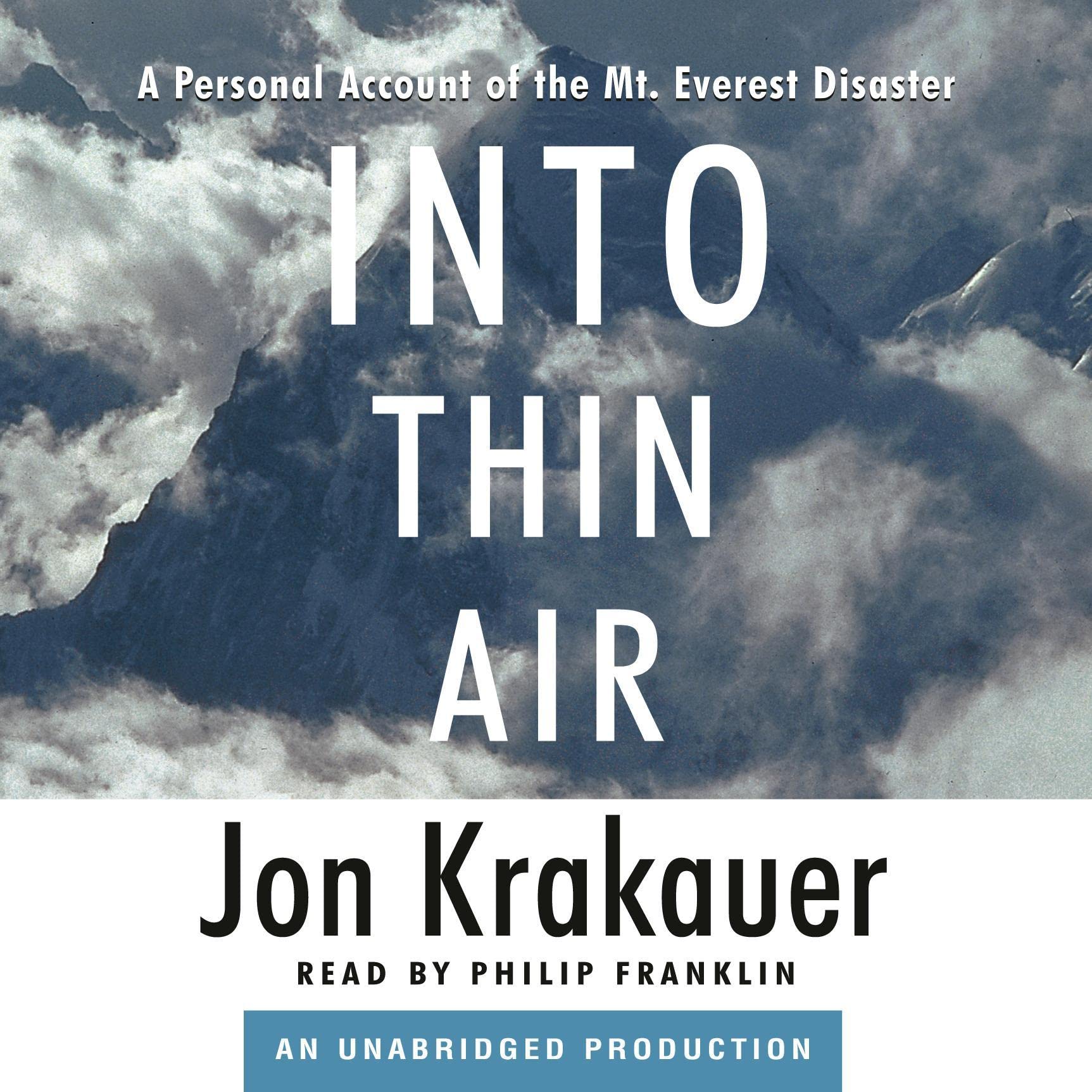
Into Thin Air: A Personal Account of the Mt. Everest Disaster
4.6 | 25,170 ratings
Price: 12.57
Last update: 05-16-2026
Top reviews from the United States
- Thomas EricksonClassic survival true story. Some survive most perish 1996 Mt Everest on top expedition. Bad weatherInto Thin Air is a top notch survival story by author and successful Mt. Everest climber Jon Krakauer, about the 1996 Mt Everest expedition climb. A few survived but most perished. This is a riveting exciting story that draws the reader in learning about the extreme difficulty climbing the tallest mountain in the world Mt. Everest and the even more dangerous and deadly decent. I found this an exciting 295 a page burner. I read it in two days and couldn't put it down.
We see in late April 1996 at the 17,600 feet base camp Ron Hall's group of paid clients, professional guides and native helpers(Sherpa) getting acclimated to low atmospheric pressure and setting up 3 camps further up for the assault to Everest's 29,028 summit. We see supplemental oxygen and DEX an injection medicine to help against brain and lungs swelling up with fluid because of only 1/3 atmospheric pressure at the summit. When going passed 25,000 feet we see that you enter the "death zone" where you start dieing. No one can live at these elevations for long and people only have a short period of time for their climb and the even more dangerous decent before brain cells die, fluids accumulate in lungs and in brain. Even the rugged Sherpa helpers are not immune to the low pressure.
We see the Sherpa being low paid and very religious and superstitious to the mother mountain. Almost all were very loyal, gave their best effort and helped the clients as much as they could.
We see a number of groups including a South African group,a Japanese group, a lone Swede, an IMAX $5 million paid group to video their accent, Ron Halls group and more.There was even a 27 year working postal worker named Hansen in his late 40s who saved money working two jobs for his second attempt at climbing Everest. There were some doctors and some in their 50s as well as a 97 pound woman,and a celebrity woman and others.
Ron Hall was a businessman and an experienced Everest climber and so was his competitor Fisher. Many of his group paid $65,000 each to be guided to the summit. INMO he took too much risks with inexperienced high altitude climbers, a celebrity woman, who with others was unqualified for the accent and a danger and a drag to other members. Hall did try to have everything organised with the best guides and local rugged Sherpa helpers used to high altitude ( many did not use supplemental oxygen) and having the team acclimated to high altitude. Climbing Everest and the more difficult decent is no game, deadly serious and death is close at all times.
Unfortunately an unforeseen weather front comes in with almost hurricane force winds and -70 below zero temperatures with snow and ice. The author Jon Krakauer and another make it to the top and just barely survive the decent. Most of the other members of the expedition make it to the top but are so weak plus having high altitude sickness INMO should of turned around and aborted the climb rather than trying to make it to the top. They are trapped because of the weather and can't come down and run out of time, supplemental oxygen and die in the "kill zone".
We see the heroism others have to try to save members who are almost frozen with severe frost bite, massive lung fluid swelling problems and others dieing before their eyes. Krakauer saves a few but even to this day is haunted that he was only about 300ft from a member and was so exhausted and almost non functioning to try to save him.
The reader learns the hardships of climbing Mt Everest and the even the more deadly part... the decent. An amazing store of inner strength, perseverance against odds but at times foolishness to continue without recognising the trouble you are in and the almost impossibility of the decent because of massive fatigue, no supplemental oxygen left and high altitude illness.
The reader gains deep empathy for the troubled survivors and the people who perish. Some of the survivors lost body parts due to severe frostbite and were psychologically scarred for the rest of their life with nightmares and more. 5 stars on this amazing survival and adventure book. - NigelBringing Mountaineering to LifeCertainly when looking towards a mountain, it doesn't seem too hard to climb. In simplest terms, spending a while training for an expedition ascending Everest, should prepare you for the time climbing towards the summit. However, we can never forget the tolls of lack of altitude on your muscles, body systems, and brain, along with the never predictable pattern of weather upon the 29,028ft summit. The climbing expedition of May 1996 is certainly not one to be forgotten, and John Krakauer still succeeds to bring it to life for readers 17 years later after the incident.
Although a book full with climbing terms, vocabulary, and history, Krakauer keeps the writing to a good pace. He never leaves the reader behind or confused, by including footnotes at the bottom of the page for further explanation. Not to mention he himself manages to include a good amount of information to the reader within his own writing style. The book provides a good base of facts and historical story references to climbs in the past, but as Krakauer embeds them within his own story line, the reader manages to not become too overwhelmed by facts. These small pockets of information are also inserted at times, which help to give the reader a bigger picture to the story.
Dealing with a serious story, Krakauer is able to still keep an enjoyable tone to his writing. He is able to keep a balance between serious and lighter writing, making the reader want to read towards the end of the story, instead of becoming depressed by the story line. He uniquely adds cliffhangers towards the end of chapters, leaving the reader never want to put the book down and stop reading. The book is a constant page-turner!
Into Thin Air may be a story of a climbing experience, but don't let that turn you away if you aren't a mountaineer. With great reporting from Krakauer himself, including quotes and past stories of other climbers, there is far more to the book than just a climbing expedition. Krakauer's own thoughts throughout the experience mixed with a collection of others' beliefs reflecting on the adventure give a whole picture to the reader. The book isn't only for those with an interest for climbing adventures.
Krakauer does a great job in bringing this story to life, and makes it a fairly easy read for those who aren't climbing experts. The book is great for those into adventure, and can really be enjoyable for a wide audience. Don't let the climbing subject take you away from the book, there is so much more to the story. After all Krakauer himself didn't originally plan on making his way up to Everest...so don't let anything stop you from joining his experience too!