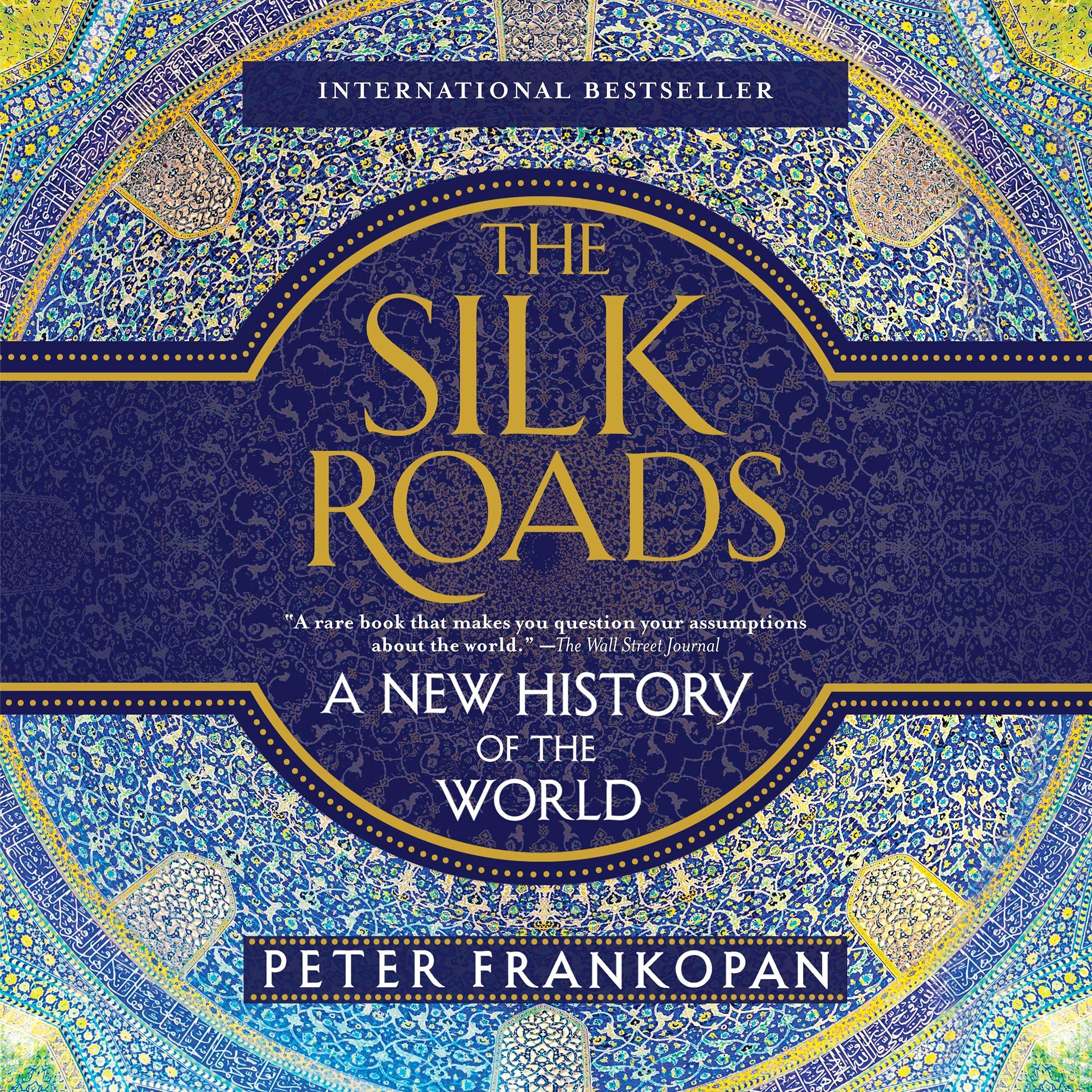
The Silk Roads: A New History of the World
4.5 | 9,467 ratings
Price: 25.59
Last update: 01-14-2026
Top reviews from the United States
- Avid ReaderA must read for anyone interested in why the world seems to be getting progressively dividedI don’t know how you enjoy reading your books, but unlike the page-turners that can’t be put down, if a book grabs my attention, I tend to slow down my pace to absorb as much as possible of the full meaning that the author intends to impart.
At 10% this book had me hooked. The realisation of how our present way of life is just a continuation of societal systems, laws and principles that were devised, implemented and set down centuries ago was a real eye opener.
I am now at around 60% and continue to be enthralled at how heavily the historical background impacts on almost every important current event and crisis that we encounter today and how different the impressions and mental pictures that emerge from the book are to those portrayed and imparted by our media.
If you are interested in why the world is what it is today, you cannot get a better more interesting precis of what events caused us to reach the state of current global development and you will better understand (but not justify) the unrest in which we live.
Staring from Roman days BC, the first 16 chapters (aprox 40% of the book) take you on an evolutionary trip through the major events, century by century, giving a foundation on how and why events of exploitation and slavery evolved as they did.
From Chapter 17 the author brings you into the 20th Century and shows how major political self-serving manipulations and greed have resulted in the unavoidable conflicts of wars and aggression throughout the history of the East and the West.
The reader cannot help but link the global terrorist activities and the peaceful invasion of Europe that we are witnessing to a resurgence of tactics and methods used throughout history to justify reaction against perceived sins that the West committed or imposed on weaker nations, which they "colonised" then simply took (or stole) their mineral, human and oil resources with no regard to the consequences on the local population and with little respect, pay-back or recompense (other than selective and ridiculous bribing of officials) to the masses of humans that they exploited, betrayed and decimated over centuries.
From the outset, the author explains why he elected to use the historical names of the people and places he describes and this becomes distracting to the reader who eventually loses track of exactly who or where the event occurs because (except for a few cases) he does not give the up-to-date name of the location or person, despite his giving the actual source references on which he bases his commentary. However, as the text gives the general location and position of an individual, readers can ignore the foreign nomenclatures and read on. This does not detracted from the text and information imparted.
The writing style flows well and is easy to read and follow. I’m looking forward to the remainder of this enjoyable journey. - Andrew DesmondWonderful Readable History“The Silk Roads” is a wonderful invigorating work of history. It is directed to the general reader rather than the specialist. I found it be absolutely riveting.
The essence of the book is that, in the West, our history is viewed through a very narrow lense. Schools teach its students of the Roman Empire, the subsequent Dark Ages, the Norman conquest in 1066, Henry VIII and the Tudors, the American War of Independence, the Industrial Revolution and the First and Second World Wars. The vast bulk of a map of the world from western Europe to China is passed over very quickly. With “The Silk Roads”, Peter Frankopan has attempted to redress this imbalance.
As the author states:
“For centuries before the early modern era, the intellectual centres of excellence of the world, the Oxfords ad Cambridges, the Harvards and Yales, were not located in Europe or the west, but in Baghdad, and Balkh, Bukhara and Samarkand”.
Moreover, Frankopan gives the reader a perspective on the rise of Mesopotamia, Alexander the Great, the rise of Christianity in the eastern Roman Empire and then the subsequent rise of Islam throughout much of Asia. He then proceeds to discuss the Crusades, the rise of Genghis Khan and his mighty Mongol Empire and then the rise of China more specifically. He concludes by bringing the book up to the present day with the rise of Europe and the USA before suggesting that there is a reorienting of history underway again. In other words:
“we are witnessing…the birthing pains of a region that once dominated the intellectual, cultural and economic landscape and which is now re-emerging. We are seeing the signs of the world’s centre of gravity shifting – back to where it lay for millennia”.
Whether you agree or not with Peter Frankopan’s conclusions, the book remains a tour-de-force. Thoroughly recommended. - evanjamesroskosNot quite a decentralized look at EurAsiaThis text is well written and well researched. Not sure what bias one of the lengthy one star reviews is talking about. Not going to get into a refutation of those complaints. What needs to be recognized here is that the focus on Europe in a history about trade routes that didn’t include Europe for quite a while is suspicious and yet this is a much better perspective than A PEOPLES HISTORY OF THE WORLD which couldn’t get out of Europe no matter how hard it tried.
I think the most impressive section is the one covering the 20th century where the author manages to weave together a number of various disasters caused mostly by the British, Russians, and Americans (as well as Iran and Iraq with the help of said Europeans).
I felt that the absence of China in various points was odd since it was Chinese silk that named these roads but overall this was a fascinating read.
I followed this up with DESTINY DISRUPTED which is a history of the world from the perspective of Islam. That gave some great perspective to this book and is recommended for anyone who read SILK ROADS.