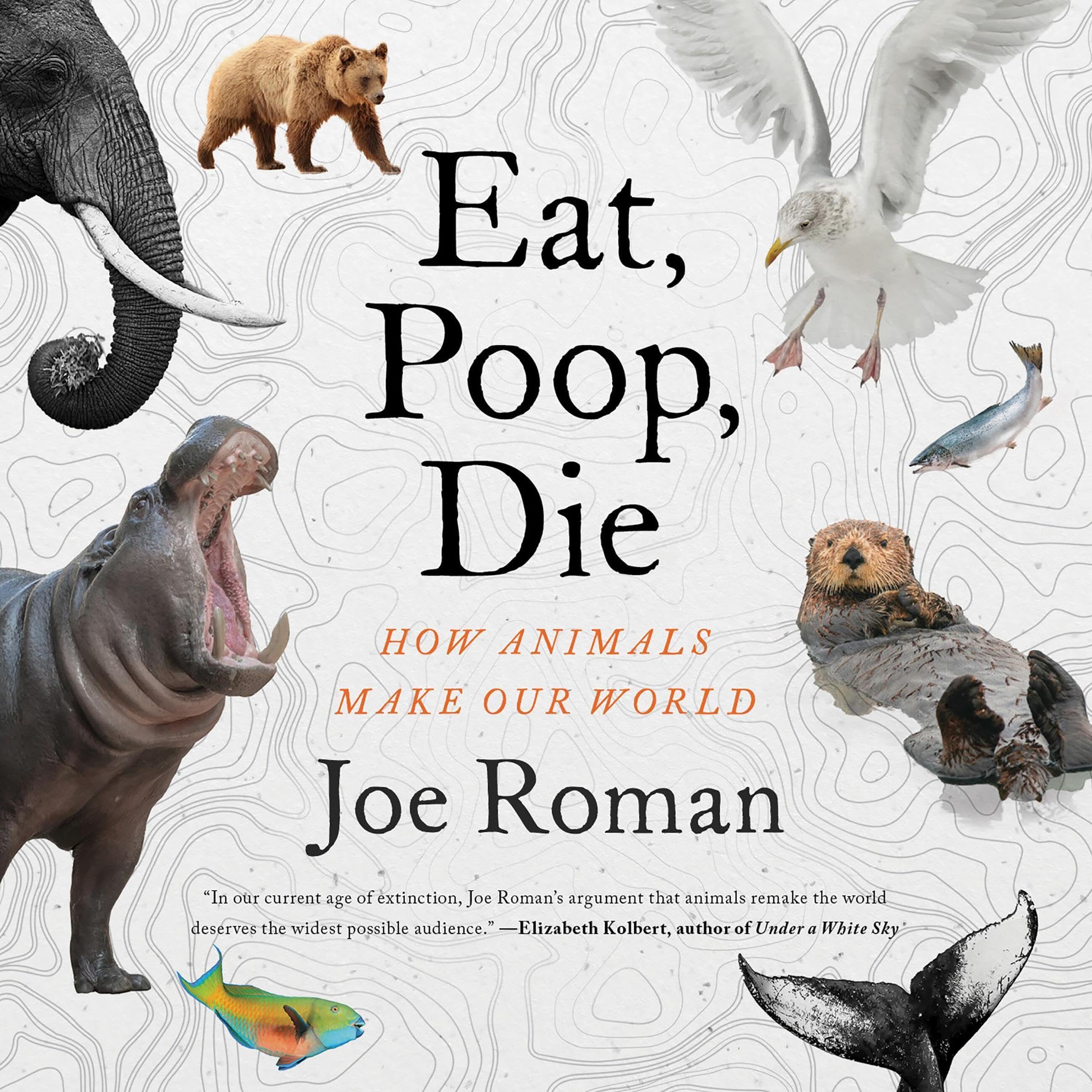
Eat, Poop, Die: How Animals Make Our World
4.5 | 75 ratings
Price: 19.68
Last update: 12-28-2025
Top reviews from the United States
- Michael D. DruckerAn Important Book For Our TimesMy IQ rose a few points after immersing myself in
Joe Roman’s brilliantly informative masterwork: “Eat, Poop, Die: How Animals Make Our World.”
Roman joyfully takes us on poetically documented scientific journeys across the hemispheres, above and below the oceans, where we learn fascinating details about a menagerie of animals from the inside out — and how each affects the gentle balance of our ailing world.
As a celebrated conservation biologist, marine ecologist, and intensely curious scholar — Roman’s humble, breezy writing style makes the complex, simple. His intimate knowledge and genuine reverence of the creatures on this planet is stunning.
“Eat, Poop, Die” is funny, too! Just jam-packed with playful, humorous moments, innuendo and one interesting fact after another. You’re still smiling when Roman pulls you in for the dire message that we need to change our behavior toward conservation to preserve our precious ecosystem. He then provides some strong suggestions.
This is an important work for sure. A must read — or a must listen — I loved the audio book as well.
Thank you for this Dr. Joe Roman!!
Please keep chasing plumes. - amachinistCan Climate Change Be Mitigated? You Bet, but It Takes All Living Organisms!The author is a biologist, journalist and an award winning author who believes that the effects of climate change can be mitigated with the help of plants, wild animals, and environmentally educated humans. The book provides a tour of a variety of biomes including volcanic islands, the ocean and the western plains of the USA. He discusses the impact of organisms as huge as whales and as tiny as midges on their habitats. He suggests humans eat less meat because over 15% of greenhouse gasses come from raising cattle. There are places all over the world where animals have been reintroduced because they were slaughtered to near extinction in these areas. Some of the reintroduced wildlife include bison, beaver and wolves. Their return has had a postive impact on their habitats. On occasion, the author is repetitive, but he offers the reader a glimmer of hope that our planet can be saved.
- Amazon CustomerExceptionally informative and well written, but...My enjoyment of this book came from two items: the remarkable number of facts I learned about the outdoors and animals; and the effective way in which the author shows what an important role wildlife plays in our universe. The final portion of the book
proposes solutions that are, in my mind, clearly not achievable and not even realistic. - Amazon Customerwish the entire world would readI learned more about our world from this book than any other book I’ve read. He also brings some humor into his story. Easy reading and definately not like a boring documentary.
Sadly I believe mankind’s will continue down this path of interfering with the balance for their political desires. - BurrFascinating BookWell written book that lightly addresses the redistribution of nutrients in nature. Not a deep, deep science book, very accessible.
- Jessi MCan we reverse the damage we've done??I’ll fully admit—I bought this book based on the title….
Now…
I’m wanting to deep dive into so many different species…and topics.
The premise of this book—
Looking at how animals help shape the various ecosystems of the planet, and how we’ve screwed those up by hunting said animals (whales, sea otters, bison, wildebeests, & so forth), or how we’ve messed things up—by building dams, turning prairies into ranches & so forth.
Reading the book…one travels from ‘newly’ forming islands (islands are less than 250 years old), to tracking whales to collect their poop, to visiting Alaska to track salmon, and so forth.
While I knew that sloths were slow moving creatures…I hadn’t realized before reading this book—they only go to the bathroom once a week…after they slowly climb down to the forest floor from the canopy.
I hadn’t realized that the wildebeest almost went extinct due to a virus jumping from agricultural stocks to the wildlife in Africa…
Nor had I given it a thought to the role that biting flies or cicadas play in the ecosystem.
The human race has caused so many problems over the past several centuries (and actually longer than that)…to the point that we’ve messed up nutrient cycles throughout the world…can they be ‘fixed’…maybe…but to do that—we have to make changes in our own society—we need to break the chains of consumerism…of wanting more & throwing things away that are perfectly functional.
Climate change is causing problems…some of our solutions are probably going to also cause problems, because we’re looking to fix a ‘snapshot’, a small bubble/piece of the problem, & probably haven’t thought of the ramifications that fix may cause…
I highly recommend this book for anyone who is interested in ecology, animals, or just looking for something different to read. I’m now going to be on the look out for books on sea otters, sloths, wildebeests, hippos, and other animals….not to mention looking up one or two people mentioned in the book as well.
Five out of five stars. - GeoGiGiNatural history, geology, biologyFascinating and so well written!
- coachajsindispensable readingMandatory reading for committed Earth stewards! Re-wilding is explained in sufficient detail to satisfy any doubter or fence clinger.
Buy 10 and give 9 of them to people who haven’t joined the sustainability chorus