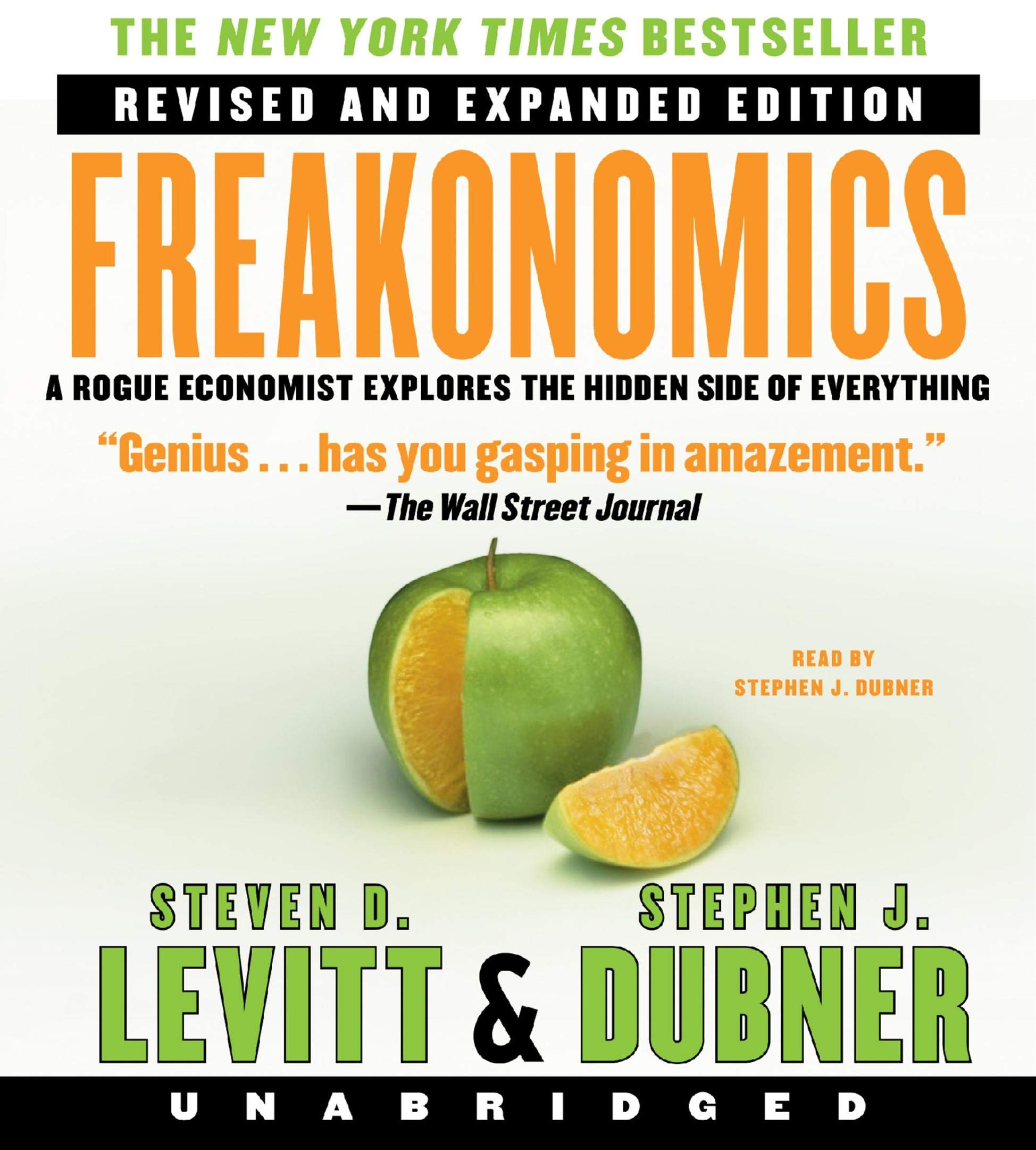
Freakonomics: Revised Edition
4.4 | 5,942 ratings
Price: 18.89
Last update: 01-11-2026
Top reviews from the United States
- ilovemigisomuchModern classicIf you work in finance, are an MBA, go to college, are an Ivy Leaguer, go to cocktail parties, like to sound smart, enjoy books like this, watch/listen to political talk shows, or are just curious, then read this book. I think anyone would truly enjoy this if they give it a chance. It's actually NOT boring and has tons of fun facts and anecdotes - it will certainly provide the reader an added view. The self-professed humble (haha) author is extremely intriguing and presents his points in intriguing, thought-provoking, hilarious, sometimes mind-boggling ways that challenge society's all too politically-correct nonsensical perspective. He particularly focuses on "rationalizing" irrational behavior, using statistics to challenge and correct common behaviors that don't make sense. Here's an example:
"No one is more susceptible to an expert’s fearmongering than a parent. Fear is in fact a major component of the act of parenting. A parent, after all, is the steward of another creature’s life, a creature who in the beginning is more helpless than the newborn of nearly any other species. This leads a lot of parents to spend a lot of their parenting energy simply being scared.
The problem is that they are often scared of the wrong things. It’s not their fault, really. Separating facts from rumors is always hard work, especially for a busy parent. And the white noise generated by the experts — to say nothing of the pressure exerted by fellow parents — is so overwhelming that they can barely think for themselves. The facts they do manage to glean have usually been varnished or exaggerated or otherwise taken out of context to serve an agenda that isn’t their own.
Consider the parents of an eight-year-old girl named, say, Molly. Her two best friends, Amy and Imani, each live nearby. Molly’s parents know that Amy’s parents keep a gun in their house, so they have forbidden Molly to play there. Instead, Molly spends a lot of time at Imani’s house, which has a swimming pool in the backyard. Molly’s parents feel good about having made such a smart choice to protect their daughter.
But according to the data, their choice isn’t smart at all. In a given year, there is one drowning of a child for every 11,000 residential pools in the United States. (In a country with 6 million pools, this means that roughly 550 children under the age of ten drown each year.) Meanwhile, there is 1 child killed by a gun for every 1 million-plus guns. (In a country with an estimated 200 million guns, this means that roughly 175 children under ten die each year from guns.) The likelihood of death by pool (1 in 11,000) versus death by gun (1 in 1 million-plus) isn’t even close: Molly is roughly 100 times more likely to die in a swimming accident at Imani’s house than in gunplay at Amy’s." - ADNEntertaining, Light (But Not More than the Market Basket Can Hold)I originally encountered Freakonomics in the New York Times, where the authors currently write an op-ed column to supplement their many sequels. I think I had also heard about the book in the context of its unorthodox approach to statistics, ie. that one of the causes of the decreasing crime rate the United States is the legalization of abortion. I not sure whether that supports a pro-life or a pro-choice argument, but this is not the place for that particular can of sandworms.
Freakonomics is a very entertaining book. The tone is light, but also authoritative and convincing. Arguments are fully explained with detailed evidence, statistics, and respectable concessions. The topics range from the crime rate and abortion, to the economics of drug deals and living in the projects, to parenting and whether cheating occurs on a massive scale in the Chicago school system (spoiler alert: it does). But there are surprises too. For example, the cheaters in Chicago are not just students, but teachers too, and drug dealers really do still live with their moms.
I would recommend this book to anyone who would like a brief overview to some principles of economics. That, or to anyone who just wants to read and interesting and funny book. If you want a deep, detailed, and technical viewpoint of some of the subjects examined in this book, you should look elsewhere to think tank studies and economics books marketed less to the general public.
Another place to find this interesting viewpoint on the world, informed by economics and a bit of creativity, is in the Freakonomics blog sometimes seen in the New York Times. The Op-Ed section of the New York Times, can be a great place to see similar perspectives, or the occasional article by the authors of this book. I enjoy these just as much as the book, and find little difference in the tone or content.
Freakonomics also lead me to another Kindle book, which I will have to review here shortly. Gang Leader for a Day by Sudhir Venkatesh.