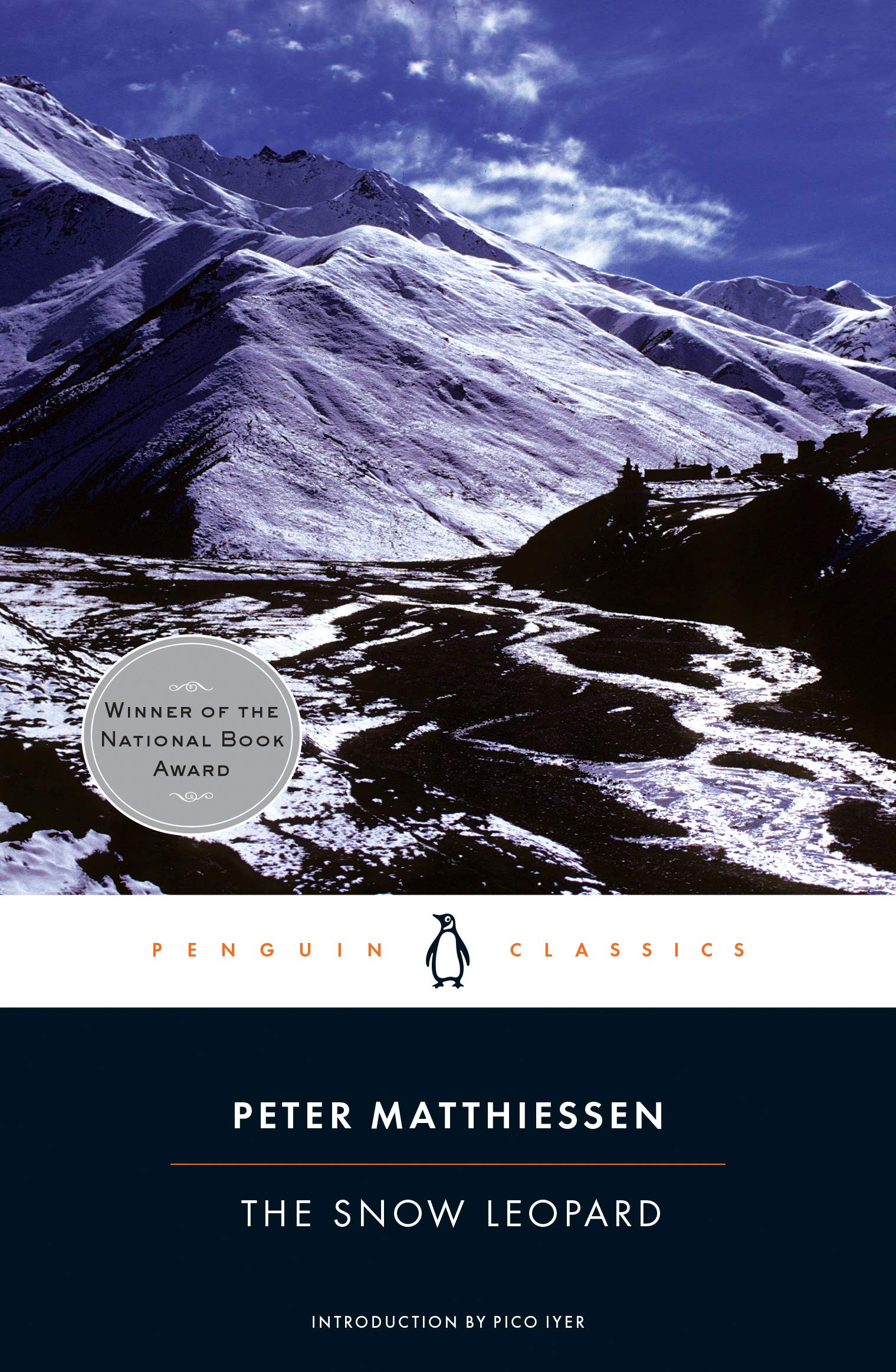
The Snow Leopard (Penguin Classics)
4.4 | 2,031 ratings
Price: 10.99
Last update: 12-30-2025
Product details
- ASIN : B00JJXV3JG
- Publisher : Penguin Classics
- Accessibility :
- Publication date : September 30, 2008
- Language : English
- File size : 4.5 MB
- Screen Reader : Supported
- Enhanced typesetting : Enabled
- X-Ray : Enabled
- Word Wise : Enabled
- Print length : 365 pages
- ISBN-10 : 9781101663189
- ISBN-13 : 978-1101663189
- Page Flip : Enabled
- Reading age : 18 years and up
- Best Sellers Rank:#1,789 in Kindle Store (See Top 100 in Kindle Store)
- Nature Writing
- Nepal Travel
- Biology of Mammals
- Customer Reviews:4.44.4 out of 5 stars(2,031)
Top reviews from the United States
- Magalini SabinaOne of the classics of travelogue literature: The Snow LeopardThoreaux: Where in all the world is the literature that gives expression to Nature?
Here it is, in Peter Matthiessens's National Book Award Winning "The Snow Leopard". Peter Matthiessen is now a living legend, a prophet of ecological thought and a long time American Buddhist, but in 1973, when the book was conceived he still wasn't so famous. At the age of 46 he decided to trek through the Inner Dolpo region of Nepal with his friend and co-explorer G. Schaller (well known for his studies on the Mountain Gorillas) to study the bharal (Himalayan blue sheep) and to try to get a glimpse of the mysterious and rare snow leopard. From September to December the two men traveled with sherpas and porters from Pokhara, around the Annapurna, the Dhaulagiri, through the Jang-La Pass, to Phoksumdo Lake to the Crystal Mountain and the Shey Gompa Monastery and back, studying the wild life and rutting habits of bharal. While G. Schaller was basically interested in animals, Matthiessen in that period a Zen scholar, utilized the travel expedition to expose his thoughts, exercise his meditation abilities, recall his memories of past experiences (drugs, deaths, remorse and expectations) but most of all to paint with lyrical pen and great descriptive talent his surroundings and the people he met.
This book is a little dated, and while reading it I was reminded of that great chapter of American writing that ties together Pirsing, Castaneda and many others, but none the less it is fascinating and gratifying because it resonates with a transcendent religious feeling of nature. In "The Snow Leopard" the ecological thought that weaves its way in all Matthiessen's works is still not full blown, but this makes the book even more incisive because the perception of his convictions lends a magic atmosphere to the travelogue. The reader has an intuition of the importance of respect of wildlife independently from modern day recriminations on its destruction.
The philosophical/religious aspect is also very interesting, because we can see the fascination of an intellectual American with Buddhist thought. Peter Matthiessen is very generous of his knowledge an puts all his rich Buddhist experience in the text, explaining history, traditions and customs of the Tibetan culture.
Matthiessen is also a very good interpreter of characters, as is evident from his novels. All the people he empathically describes jump out of the page and come to life. The canny and mysterious Tukten (maybe a guiding figure like Dante's Virgilio or a true Bodhisattva) and the naïve and faithful Dawa become our friends as well, but also the many minor encounters like the Lama of Shey pass forever into literary history to be remembered.
Two points of highlight are how the Author manages to convey the pleasure and the fatigue of the physical trip. I could actually feel his boots and the joy of having broken them in, the discomfort of the sun glaring on the snow and the beauty of the birds, flowers and landscapes he describes. The second is the excellence of the prose. Selected paragraphs are poems of beauty and the perfect use of the English language is in itself a reason to rejoice.
This book is also a very personal and introspective diary. It talks about the man and his problems and probably this is the single most touching point of this great nature classic. At a distance of 30 years, people are taking guided trekking tours to Shey Gompa and its protected Natural Park, and much of the mystery has dissolved, however still few have seen the snow leopard, and discussion is still raging on the existence of the Yeti or Bigfoot.
Read and reread this nature classic to capture all its merits. It is landmark of the American perception of Buddhism, ecological thought and one of the best travelogues around. - Long journeyI enjoyed this classic. It held my interest as a travelogue with some Eastern Wisdom. However it should have been better. Many descriptions are beautiful but I sense that there was no real central focus. Notes with comments. Too bad.
- fov booksA trip worth taking on many levelsPeter Matthiessen considered himself primarily a fiction writer, though his non-fiction output was nearly twice as heavy. He is the only writer to have won the National Book Award in both categories. Matthiessen, who died in April of this year, was a well-known literary figure, traveler, naturalist, environmentalist, and Buddhist. A couple of his novels, Far Tortuga & Shadow Country, rank in the highest tier of my personal favorites.
The Snow Leopard is a famous book that recounts the author’s 1973 journey to the remote mountains of Nepal with field biologist George Schaller, who went to study the Himalayan blue sheep. Matthiessen went along for several reasons, for the high altitude flora and fauna, the most elusive of which is the snow leopard, and for spiritual reasons having to do with a pilgrimage to the ancient shrine on Crystal Mountain, as well as a more personal quest to understand reality and suffering, prompted by the recent loss of his wife to cancer.
I read this book slowly, partly due to my recent schedule but mainly to savor the words, as seemed best upon my encounter with them. The related journey is a combination of sheer arduous traveling, a Buddhist history of the region, a seeker’s inner path, a traveler’s account of the lives of the people living there, and as usual with this writer, lyrical descriptions of the natural world in its many forms.
Like the mountain journey itself, the passages move up and down with the landscape, changing with the weather and the reader’s mind, finding footholds in different areas of interest, holding true in sparkling moments of transcendence that balance more mundane points in other spots. There are wonderful observations of locals, both human and animal, and the inner struggles of a spiritual man who rises and falls in his attempts at betterment. Written as daily journal entries, the accumulation of the details of hardship and progress and doubt and beauty and loss began to gather within this reader and alter his perceptions in ways both subtle and profound.
In most ways this journey is no longer possible, in all likelihood not politically feasible, while the region itself is no longer as remote as it was forty years ago, not to mention the fact that many readers would not relish or even be capable of the physical demands. Here then is an opportunity to experience something of this incredible undertaking and feel this mystical, ethereal high country – in a staggering and moving accomplishment.
Here are two passages to illustrate the reflective and physical aspects of the journey.
When I watch blue sheep, I must watch blue sheep, not be thinking about sex, danger, or the present, for this present – even while I think of it – is gone.
In the cold wind, the track is icy even at midday, yet one cannot wander to the side without plunging through the crust. The regular slow step that works best on steep mountainsides is difficult; I slip and clamber. Far above, a train of yaks makes dark curves on the shining ice; soon a second herd overtakes me, the twine-soled herders strolling up the icy incline with hands clasped behind their backs, grunting and whistling at the heaving animals. - NY PersonA philosopher naturalist goes on a journey. How can you not be interested?A great book for anyone who genuinely loves the natural world, and with a genuine interest in religious philosophy, which is to say anyone who thinks seriously about who we are and what we're doing with our lives. You don't have to accept his theology, such as it is (and I believe Matthiesen would deny that he had one, in the sense of a rigid system of fixed beliefs). But he clearly was (is, the literary and Buddhist sense) a man of great sincerity, and a probing intellect.
None of this takes away from the book as a tremendous, beautifully written journal of nature and exploration. And, there is more than a layer or two of psychological /novel-ish interest in the backstory of his wife's recent death, and his ambivalence (and some guilt) in what he intermittently perceives as an abandonment of his son. And, there is a tremendous, well-written story of personal courage and endurance woven into all the above.
There are some books which can fairly be described as life-changing. Again, not to say I or anyone is adopting a particular person's worldview as their own, or something entirely new. But there is much in this book that stays with you and resonates. I've bought it for close family, and recommended it to my boys. I don't think anyone would regret reading this, or not come away with something they're glad to have thought about.