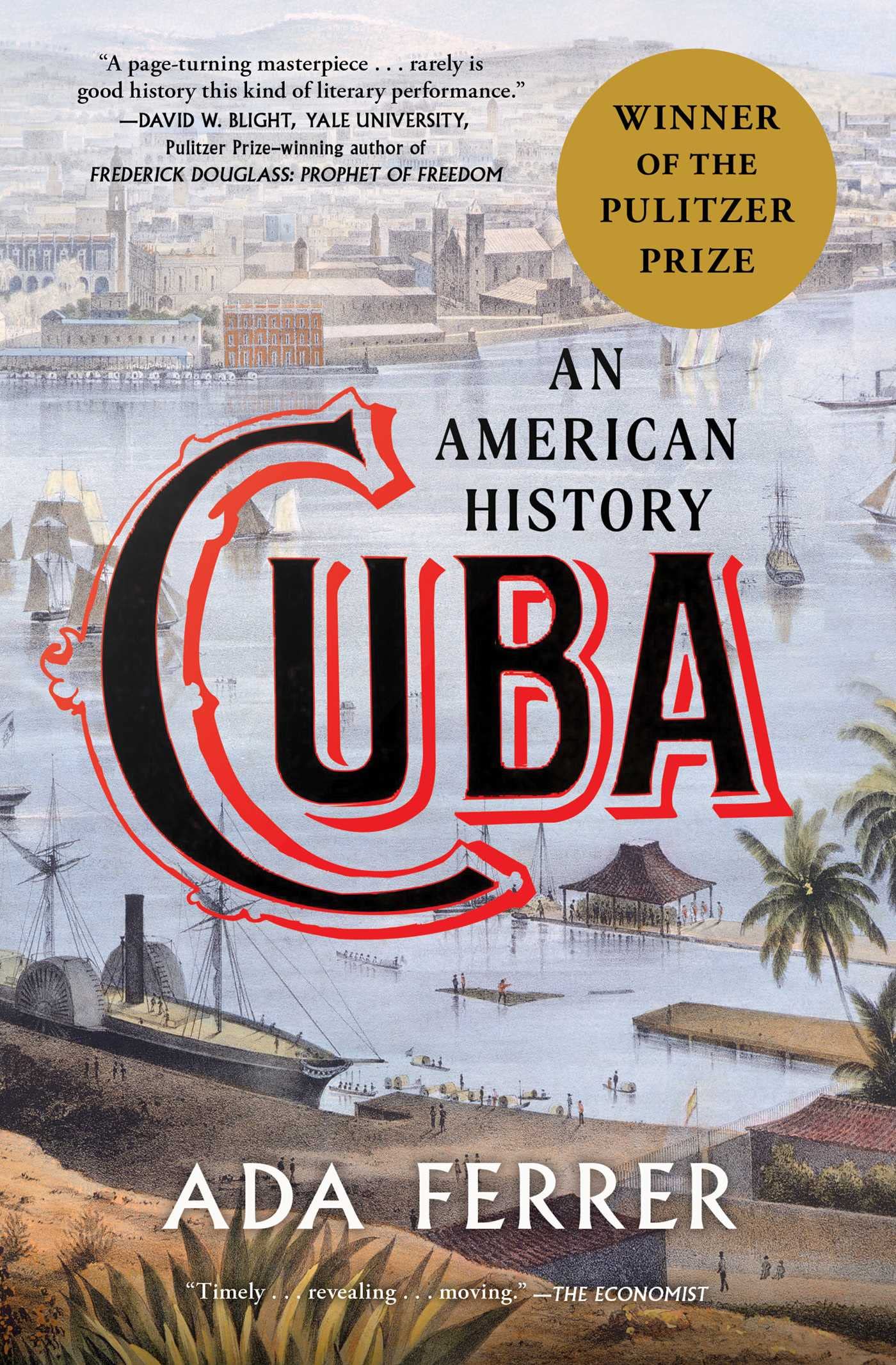
Cuba (Winner of the Pulitzer Prize): An American History
4.6 | 1,979 ratings
Price: 12.99
Last update: 03-31-2026
Product details
- ASIN : B08LDWX3G3
- Publisher : Scribner
- Accessibility :
- Publication date : September 7, 2021
- Language : English
- File size : 22.8 MB
- Screen Reader : Supported
- Enhanced typesetting : Enabled
- X-Ray : Enabled
- Word Wise : Enabled
- Print length : 566 pages
- ISBN-13 : 978-1501154577
- Page Flip : Enabled
- Best Sellers Rank:#472 in Kindle Store (See Top 100 in Kindle Store)
- History of Cuba (Books)
- History of the U.S.
- History of Central America
- Customer Reviews:4.64.6 out of 5 stars(1,892)
Top reviews from the United States
- Hugo JohnsonTerrific one-volume history of Cuba-US historyThe kind of book that reminds you why you love history--great narrative, great analysis, written with passion. Highly recommended.
- Lucas Jdelightful to read, and an important history for US citizens to knowIf you like survey histories and don't know much about Cuba (and you live in the US), I highly recommend this book. Not only does it cover key events and forces inside and outside Cuba that have shaped it, it's very readable and with on-the-ground anecdotes and quotes, brings to life how events probably felt to the people in or around them.
BUT - to take it a level beyond "interesting & readable history book," I think this type of book is *important* to read. Personally, Cuban history was not covered in my public k-12 education in the US, except for the Cuban missile crisis. And due to the embargo, my knowledge of the place and its people has been pretty minimal. (And I think that is probably a very common experience.)
Which is unfortunate, because Cuba is one of the US's few direct neighbors. Our histories, like with Mexico or Canada, are very intertwined. Havana has been a cultural hub for the entire hemisphere for the last 500 years, due to where it sat on the gulf stream trade routes between Europe and the Americas, with as much of a musical influence as NYC and New Orleans. Our relationship with Cuba even shapes presidential elections, or led to a nuclear missile crisis... To ignore it is to miss an important part of our own history, and how you treat your neighbors can cause tragic boomerang impacts.
To that point, Ferrer frames Cuba's history as an "American" one, that it is hemispheric and intertwined with the US. What she brought to light (for me as a US citizen) was how the US has hungrily viewed Cuba as a place where we can extend our influence & economy. In that self-absorbed mindset, we've missed seeing Cuba's distinct history. We elbowed into their revolution from Spain and claimed them as a de facto vassal via the Platt Amendment. Then an era of progressive and revolutionary Cuban activism during the first half of the 20th century gained political "independence" from the US, at first from the Platt Amendment, then also economically with the nationalization of US-owned holdings under Castro. And thus relations deteriorated completely.
Obama's effort to reconnect was a step in a new direction, more as partners and neighbors, but that change is doing some zig zags. Ferrer ends on a hopeful note about we all play a part in shaping the future. So as the book wrapped up, I wondered what a voter in the US might do. Even with a rapprochement, the economic imbalance (small poor country adjacent to a juggernaut) yields these high voltage differences that cause shocks when they connect. US investors eagerly bought up land & plantations a century ago when the revolution had suggested opportunity for all Cubans, then there were flash waves of migrants over the last sixty years. In electric systems you need good transformers that step-down the voltage level, and the question is what could those transformers be between the US and Cuba in the coming decades.
No matter what, Cuba is our neighbor. And becoming better neighbors requires getting to know them, empathizing with their perspective, understanding how you're viewed and what your impacts are on them. A book like this is an important part of that journey, and it was great to read.
Strongly recommend! - Gene KillianA compelling but imbalanced history of CubaI have mixed feelings about this book. On the one hand, Ferrer is an excellent and engaging writer, and gives the reader an impressive recounting of 500 years of Cuban history. The book is definitely worth reading.
On the other hand, she seems to have tunnel vision about some of the more troubling aspects of the history of the Cuban government, and I wonder whether her political views have caused her to eliminate important facts.
Her central thesis is that Cuba has been a target of repression and manipulation by Western governments, principally the United States, for centuries. This, perhaps unfortunately, leads her to describe the exploits of Fidel Castro and Che Guevara as those of swashbuckling saviors out to protect the little people. As a result, she glosses over the deprivation of due process and the many murders that Castro and Guevara engaged in, which the Cuba Project estimates exceeded 10,000. She does not talk about the regime’s use of concentration camps, or extrajudicial imprisonment. Nor does she talk about the racism discovered in Che’s diaries after his death, particularly about people of color and Mexicans.
She writes glowingly about Castro instituting agrarian reform (in other words, confiscation of land), better health care, higher wages, and equality between men and women. But she has no good explanation for the hundreds of thousands of Cubans who fled the country (including on improvised rafts), even before the collapse of the Soviet Union. She tries to get around this by contending first, that some of these people supported Fulgencio Batista, and second (not kidding) that refugees from Cuba were principally unhappy because Castro made them repeat “revolutionary” slogans. That struck me as ridiculous.
While she complains a lot about the US meddling in Cuban affairs, she is nonjudgmental about the Soviet Union becoming involved in Cuba, even though the heavy-handed Soviet government kept the entirety of Eastern Europe behind walls.
One minor point: She manages to describe the Spanish-American War without mentioning the Battle of San Juan Hill. (In fairness, late in the book, she talks about a painting in the White House depicting the battle.) Yes, the battle was a minor skirmish. Yes, the war was pretty much over when it happened. But a future US President was involved in the Battle, which, I think, merits a couple of paragraphs. What was the battle about? How did TR get there?
The bottom line is that this is an important, enjoyable, and well-written book. But I would suggest reading it with a bit of skepticism.