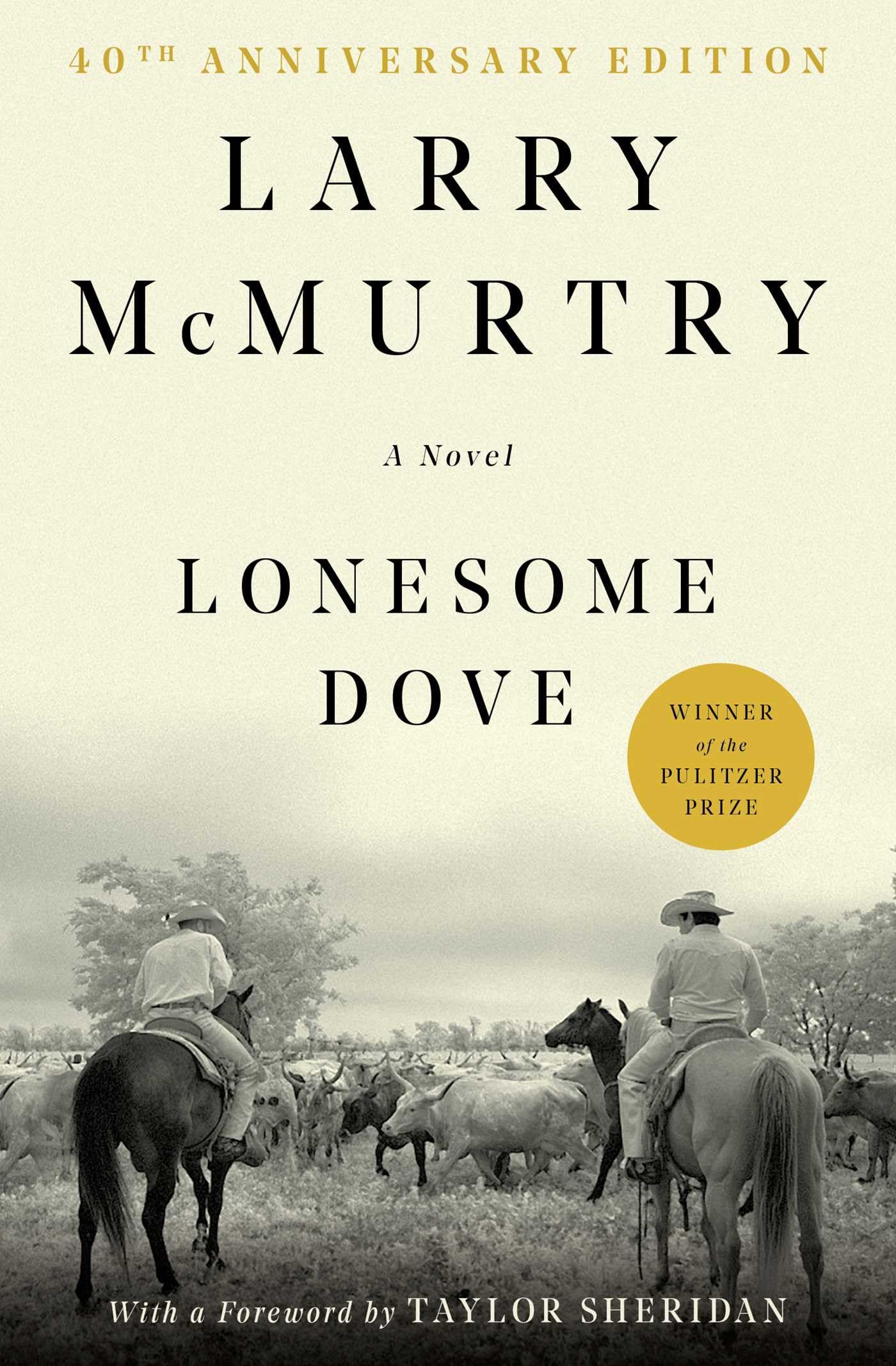
Lonesome Dove: A Novel
4.8 | 26,025 ratings
Price: 16.99
Last update: 03-31-2026
Product details
- ASIN : B003NE6HD4
- Publisher : Simon & Schuster
- Accessibility :
- Publication date : May 24, 2010
- Edition : 25th Anniversary ed.
- Language : English
- File size : 3.6 MB
- Screen Reader : Supported
- Enhanced typesetting : Enabled
- X-Ray : Enabled
- Word Wise : Enabled
- Print length : 864 pages
- ISBN-13 : 978-1451606539
- Page Flip : Enabled
- Book 3 of 4 : Lonesome Dove
- Best Sellers Rank:#13 in Kindle Store (See Top 100 in Kindle Store)
- Native American Literature (Kindle Store)
- Historical Fiction (Books)
- Classic American Fiction
- Customer Reviews:4.84.8 out of 5 stars(26,013)
Top reviews from the United States
- Nick Wisseman (author)Easy to Read, Impossible to ForgetLarry McMurtry’s Lonesome Dove starts with pigs and ends with sorrow. In between lies one of the best books I’ve ever read.
The novel is set in the American West after the Civil War. The protagonists, Woodrow Call and Augustus “Gus” McCrae, are former Texas Rangers who retired a decade ago and spent the intervening years in the little Texas town of Lonesome Dove. Nominally, they run the Hat Creek Cattle Company with a few of their old comrades (and two blue pigs, who kick off the book by eating a snake). But mostly they’re just whiling away the hours.
This part of the story is easy, pleasurable reading. McMurtry writes in third-person omniscient, meandering from one character to the next and bringing them to life quickly and completely. Call is a workaholic prone to brooding. (“Give Call a grievance,” we hear early on, “however silly, and he would save it like money.”) Gus is voluble and lazy. Pea Eye is simple but solid. Deets is as reliable as he is quirky (he makes his pants out of quilts). Newt is young and desperate to please.
Even minor characters get distinctive traits. Lippy “was so named because his lower lip was about the size of the flap on a saddlebag. He could tuck enough snuff under it to last a normal person at least a month; in general the lip lived a life of its own, there toward the bottom of his face. Even when he was just sitting quietly, studying his cards, the lip waved and wiggled as if it had a breeze blowing across it.” And Joe “had a habit of staring straight ahead. Though Call assumed he had a neck joint like other men, he had never seen him use it.”
For a while, it seems like the Hat Creek crew might putter around Lonesome Dove forever. Then Jake, another ex-ranger—on the run from the law, as it happens—rides into town and mentions that he’s been to Montana and seen vast tracts of good, unsettled land there. This lights a fire under Call. He spurs the boys into motion, leading them on cattle raids across the Mexican border and hiring extra hands to help drive the animals north. So begins a great, three-thousand-mile trek from some of the lowest latitudes of the country to the highest.
Things get hairy almost immediately. Death comes fast on the drive, and the dangers are too varied to guard against: snake-plagued river crossings, lightning storms on the open plains, searing droughts, and worse. Likable characters are abused and killed. Some of your favorites won’t make it. Prepare to be heartbroken.
Yet there’s no grand goal here. Call and Gus aren’t trying to open up the American West—they already served their time protecting settlers along the shifting frontier. Montana is a vague destination, not a mission; Call essentially leaves Lonesome Dove on a whim. Gus goes along for lack of anything better to do, but not eagerly. “Here you’ve brought these cattle all this way,” he complains to his partner around the halfway mark, “with all this inconvenience to me and everybody else, and you don’t have no reason in this world to be doing it.”
McMurtry has plenty of reasons for the drive, though. In his preface to the 25th-anniversary edition of Lonesome Dove, he argues that “the central theme of the novel is not the stocking of Montana but unacknowledged paternity,” namely Newt’s. His mother is long dead, and his father might be one of the Rangers.
But that wasn’t the thread that stood out most to me. The book is filled with restless souls regretting all sorts of errors. Gus wishes he’d married his sweetheart when he had the chance. “I expect it was the major mistake of my life, letting her slip by,” he tells Call. For his part, the quieter man laments getting involved with women at all. Jake can’t believe he’s committed hanging crimes. July Johnson, the Kansas sheriff pursuing Jake, hates himself for leaving three of his charges to face a murderer. And so on.
Aging is the through-line here—aging and change. Gus and Call are past their primes. They were legendary Rangers once, but now they’re fading into irrelevancy. The younger generation doesn’t hold them in the same esteem. “I guess they forgot us, like they forgot the Alamo,” August observes after the owner of a bar tries to kick him out for demanding respectful treatment. “Why wouldn’t they?” Call answers. “We ain’t been around.”
The West is moving on too. The buffalo are nearly done, pushed to the brink of extinction by wasteful hunting. Gus rides past several slaughter sites where it looks like “a whole herd had been wiped out, for a road of bones stretched far across the plain.” The Native Americans aren’t in much better shape—despite their fearsome reputation, their numbers have dwindled in tandem with the buffalos’. “With those millions of animals gone,” Gus reflects, “and the Indians mostly gone in their wake, the great plains were truly empty, unpeopled and ungrazed. Soon the whites would come, of course, but what he was seeing was a moment between, not the plains as they had been, or as they would be, but a moment of true emptiness, with thousands of miles of grass resting unused, occupied only by remnants—of the buffalo, the Indians, the hunters.”
This is all tragic, but it’s beautifully done.
A couple things bothered me, however. That 25th-anniversary preface contains what feel like major spoilers. They aren’t, but I’d still skip this section until you’re done with the story proper. (Unless you want to start the book as grumpy as I did.)
More significantly, while Deets shines as the only African American in the Hat Creek outfit (“He’s the best man we got,” Call says late in the drive; “Best man we’ve ever had,” Augustus agrees), the one Native American that gets extended time on the page is a vicious monster. We meet some friendlier indigenous people in passing, but I kept waiting for a real counterweight: a kind Comanche, or a decent Sioux. It never happens. (To be fair, McMurtry does have Gus take a few stabs at articulating why the Native Americans aren’t always hospitable. “We won more than our share with the natives,” he remarks near the end of the novel. They didn’t invite us here, you know. We got no call to be vengeful.” And earlier, he puzzles Call by saying, “I think we spent our best years fighting on the wrong side.” I don’t think this is enough, but it’s something.)
Other than that … it’s hard to complain. Lonesome Dove doesn’t close with a climactic shootout like you might find in other westerns. But it doesn’t need to. The journey—Gus and Call’s last shot at big, unnecessary adventure—is the point.
And it’s a masterpiece. - kemckinsWhat a gem, READ IT!This book, my goodness. Such great story-telling by McMurtry. The character development is some of the best I’ve come across so far. These people and their experiences are real. I’m amazed. I was a little intimidated by the length at first, and I never thought I’d read (and thoroughly enjoy) a western, but I’m glad I decided to take it on and dive in. By far one of the best novels I’ve ever read. A sense of calm and comfort enveloped me every time I opened it. It was an absolute delight. Highly recommended.
- Walter DesmondStarts off slowly but this is one amazing novel!I am not a stranger to westerns. I remember my grandfather always reading some Zane Gray novel, and my father had read his share of Louis L'Amour. On TV, you couldn't change the channel without running into some show about cowboys, gamblers and gunslingers---from Bronco Lane to Cheyenne to Bat Masterson to The Rifleman to Rawhide. Yet---at least with regard to reading material, I tended to lean toward the Conan novels of Robert E. Howard and the science fiction of Lin Carter.
Still, in retirement and finding the time to read all those books I'd always been meaning to get around to, I finally read Lonesome Dove---decades after it had been published. And I'd been told that I might find the first few chapters kind of boring---which I did---but to push on through until the cattle drive started---which I did. And what a novel it turned out to be! Vivid, unforgettable characters---from the major ones like Gus and Call---to the more minor ones like Janey. Vivid descriptions of terrain. Vivid, unforgettable scenes, like the nest of water moccasins on the Nueces River, to Gus' poignant death scene as he lies in a bed listening to piano music being played by a consumptive prostitute, to Pea Eye's naked trek back to Call and his companeros and the cattle herd. Even the animals were interesting---from Call's Hell Bitch, to the feisty little bull who charges the bear in Wyoming, to Gus' two sturdy and intrepid pigs.
The author did one heck of a job juggling all those characters and sub-plots. It all cohered, and I did not feel lost once as I made my way through a book that is almost 900 pages.
In the end, I did not rejoice and I did not cry. I felt a great emptiness. I felt, in a word, lonesome. So, for me, McMurtry did his job well. You have to wonder at times what kept the characters going when it sometimes seemed all for nothing---yet the fact that they did keep going stands as a testament to courage, stamina, determination and sacred promises made to others. These things do cut the loneliness to some degree, but the vast and beautiful American landscape was---and is---an often lonely place.
I will probably watch the 4-episode series presently streaming on Peacock. though Robert Duvall and Tommy Lee Jones are not the actors that came to mind as a I read the novel. - MJZHumour and HeartbreakI don't have any interest in cowboys or the Old West. I mean a story about a cattle drive sounds pretty dull, right? I could not have been more wrong! This is one of the most incredible reading experiences I have ever had, and as someone with a degree in English literature, I've read a lot of books. This is very much a character-driven story and it is almost impossible to not fall in love with some of them. This book is full of humour and heartbreak.
It was brought to my attention a few times, but I kept ignoring it as it wasn't "my thing." But when I saw some booktubers, who I respect, gushing over this I knew it was time. It's a commitment at 858 pages. However, I did not regret a single moment I spent with these characters. One thing I will advise is to NOT read the preface! Why this huge spoiler is in the front of the book is beyond me to understand. There are some disturbing scenes in the book but they are balanced out by the humour and humanity of the characters. I can't recommend this book highly enough. I never thought a book about cowboys would become one of my all time favourite stories but that is how enthralling and heart-stirring this book is!