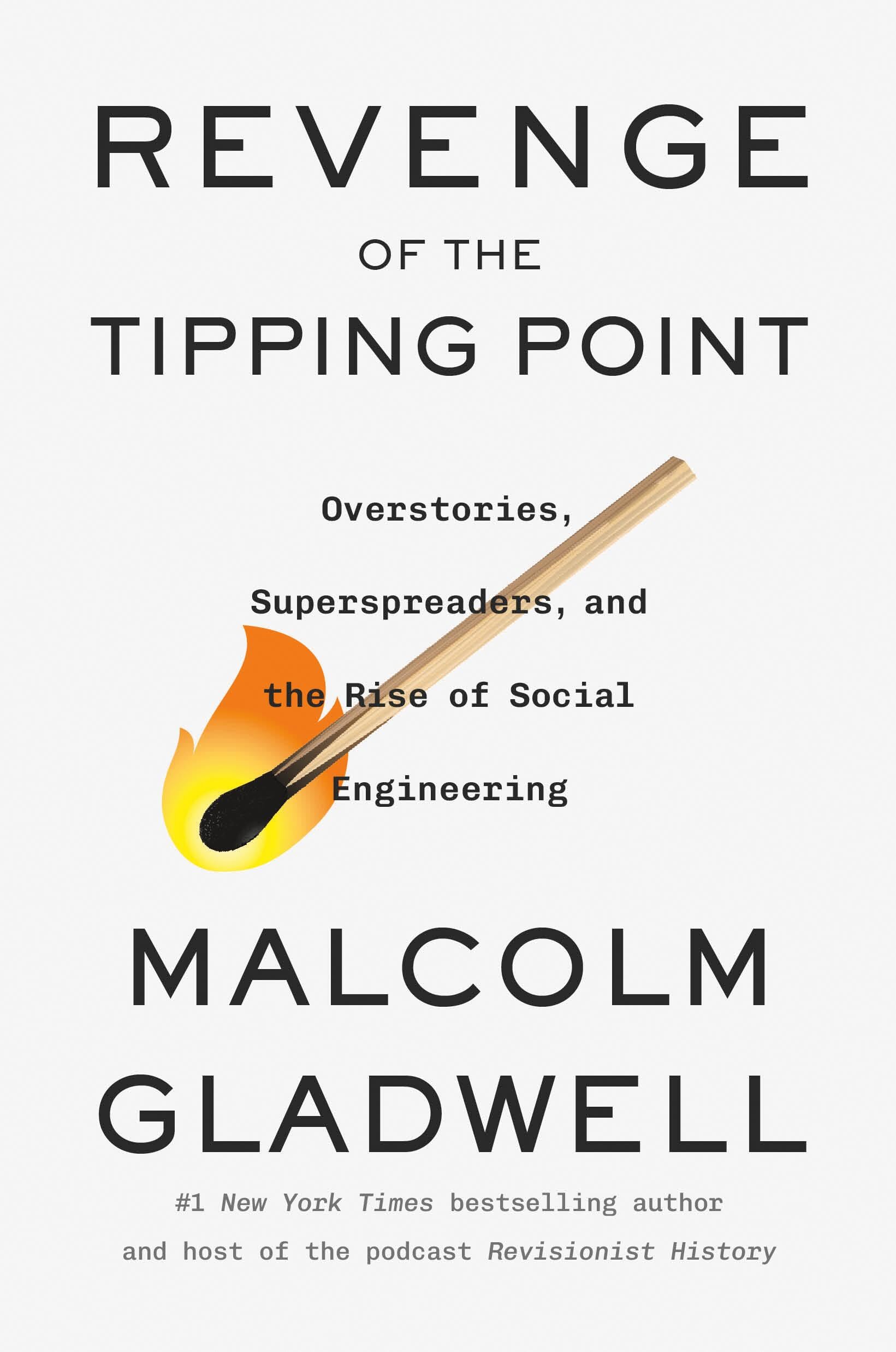
Revenge of the Tipping Point: Overstories, Superspreaders, and the Rise of Social Engineering
4.4 | 5,540 ratings
Price: 15.99
Last update: 03-02-2026
Product details
- ASIN : B0D59PL1BZ
- Publisher : Little, Brown and Company
- Accessibility :
- Publication date : October 1, 2024
- Language : English
- File size : 8.5 MB
- Screen Reader : Supported
- Enhanced typesetting : Enabled
- X-Ray : Enabled
- Word Wise : Enabled
- Print length : 345 pages
- ISBN-13 : 978-0316581479
- Page Flip : Enabled
- Best Sellers Rank:#14,968 in Kindle Store (See Top 100 in Kindle Store)
- Market Research Business (Kindle Store)
- Statistics (Kindle Store)
- Statistics (Books)
- Customer Reviews:4.44.4 out of 5 stars(5,188)
 Revenge of the Tipping Point: Overstories, Superspreaders, and the Rise of Social Engineering
Top reviews from the United States
- Jeffrey LGladwell Revisits Tipping Points, and looks at the dark sideMalcolm Gladwell returns by revisiting the topic of his first book: The Tipping Point. As he states right at the beginning (pg 7) "I want to look at the underside of the possibilites I explored so long ago. If the world can be moved by just the slightest push, then the person who knows where and when to push has real power."
Gladwell writes the book in a style that will be familiar with anyone who has read his previous books. He is a gifted storyteller and each facet of the argument he is trying to make is introduced with a story.
(Spoilers from here on out)
Summary: Gladwell tries to find the mechanisms that explain the opioid epidemic in the US (prescription and illicit drugs). Gladwell shows how Purdue Pharma, along with guidance from the consulting firm McKinsey, leveraged certain concepts about the nature of epidemics to create the current crisis.
Through the process he explores concepts including, "small town variation," "overstories" - which he explains is his word for something resembling a Zeitgeist, revisits "tipping points" and monocultures among other topics.
Central to his perspective is the way that stories shape our perspective, and how those who tell stories can shape the public consciousness. He gives a number of examples that capture this vividly.
Along the way he grapples with some knotty moral questions. He explores engaging with minor discrimination to prevent vicious discrimination. He raises the issue of better methods of identification of potentially leading to profiling disadvantaged groups (in his primary example, the COVID virus was more likely to spread from people who were elderly and overweight.) He has an interesting perspective on Ivy League schools like Harvard using sports teams to maintain the student balance that they desire.
Why should you read this book?
- Gladwell is a writer who is not scared to ask big questions or explore knotty issues. His discussions about discrimination and about the way that the introduction of Purdue's OxyContin gummies actually exacerbated the situation raises some challenging questions.
- Gladwell's writing style is engaging and fun to read. I read the book over a 24-hour period and am sure many others will do the same
- Gladwell brings up anecdotes and stories that are not well known and will likely cause you to reconsider how you see things that you thought you knew.
Some other notes:
- Gladwell has stated at public lectures that looking back, there are aspects of his earlier writing that he no longer agrees with. Gladwell is someone who is clearly constantly exploring and learning and is not afraid to change his perspective on topics. I view his writing as deeply thought provoking but do not assume they are hard facts. (In this book, I have a hard time seeing how Madden's triplicate forms would be considered an 'overstory' rather than a technical reality that impacted the drug epidemic.
- Many of Gladwell's previous books have introduced ideas that were widely adopted (tipping point is just one of them), so I would expect ideas from this book to circulate pretty widely.
- This book does not discuss how social media impacts public opinion. It never mentions 'fake news,' contemporary politics, or other aspects of modern society (in 2024) that I had expected from the title.
Is it for children: The book talks about Medicare fraud, drug abuse, suicide, White Flight and the Holocaust, so there are quite a few heavy topics. I do not recall any profanity or sexual content.
Conclusion: Gladwell has put out another fascinating book that spans a wide range of topics and is sure to leave you thinking. It is a quick, engaging read, even as some of the topics are quite heavy.
As with Gladwell's other books, it is sometimes hard to tell if everything seems to be tying together neatly because in fact they do, or if it is Gladwell's skill as a writer that makes it seem so. Reviewing the notes I wrote on the book, there were aspects that I was not sure fit perfectly, though that may be an indication of the limits of my understanding of the book, rather than a flaw in the content.
Overall, it is a fun read that is thought provoking. And as noted, because Gladwell is so widely read, it seems likely that elements of this book will become widely known and shared. Interestingly, he touches on some ideas from The Tipping Point but almost never references them directly or even acknowledges which ideas he discussed in his earlier book. - Nathan PereiraGood bookGood book. It’s a good light read, nice analysis of the opioid pandemic among other things. Like tipping point.
- Gary Moreau, AuthorTruth is in the details.The title of this book could have been: “The Etiology of Change.” Etiology is a medical term meaning cause. And I use it here because Gladwell, as he did in the first Tipping Point, frames change in terms of an epidemic.
The tipping point, of course, is the mass at which a duality moves inevitably, and often quickly, in the other direction. It’s important because all of existence is defined by dualities. Up is always accompanied by down. Left doesn’t exist without right. And so it is with the many social trends, such as housing, college acceptance, and the opioid crisis in which there are identifiable groups of individuals which share a distinguishing common trait (e.g. race, religion, addiction) within the larger group.
The objective I believe the author is seeking is how to restore balance when imbalance shows its ugly mug. The search for balance is ubiquitous to nature because of the universal existence of dualities.
The topics that Gladwell addresses (e.g., Why does Harvard have a women’s rugby team?) are as obscure as those he shared in the first book. And that alone makes the book informative and entertaining. He definitely has a nose for the obscurely interesting.
And, as in all his books, the research is thorough and impeccable. He does, however, spend a lot of time quoting third parties in order to build his case. Perhaps more than necessary. I personally wish he spent more time expanding his conclusions. He has a strong enough reputation that he can assume our acceptance of his source observations.
His conclusion, as I read it, is that we can understand far-reaching but perplexing social trends by looking into the details. The truth, or at least the greater truth, always hides there. And if we can uncover it, we can address the problem.
Resolving the problem may not always be seen as “fair,” however. The solution, as he notes, is often counter-intuitive to society’s pre-defined solutions to the problem. And that’s where the book sometimes just stops. There are few real prescriptions for how to overcome that hurdle. I suspect Gladwell considered that to be beyond the scope of the book, but it did leave me wondering, “Okay, but what do I do with that?”
To me, this is a book about context. We do tend to oversimplify everything in our everyday public discourse. And certainly in this election year the oversimplification is at a fevered pitch. We’re just yelling myths at each other. The world is far more complicated and nuanced than either political party is currently acknowledging.
In that regard, this book is timely although Gladwell does not enter the political fray at any level. The book is more investigative journalism than opinion piece.
Gladwell is lucid and profoundly curious. The book is an easy read, and you should be able to finish the book in just a couple of days. It is worth the time. - Carolina regularRiveting read and important to knowOf all of the Gladwell books—and we have enjoyed them—this may be the most page turning. It also may be the most important one to understanding the complications and critical tipping points of MODERN life, informing us of the critical factors in thinking about how to go forward with them.
It is a valuable primer on social engineering that not many of us have been thinking about, but that should be more important to us in understanding TODAY’S sociology. It should be assigned reading in any sociology course at any level. It would also be the most popular assignment. - Aussie JanineRepetitiveThis is modestly interesting not very repetitive. The while book and it's concepts could be covered in 1/5 of the pages and 1/5 of my time.
- PontoWorth a readThought provoking book. Interesting follow up to the original Tipping Point. Well reasoned and researched stories that are tied together in typical Gladwell fashion.
- Gayle ramsdellWell worth the readI ordered this as a gift and once they finished it I had a chance to read it. If you have read the original Tipping Point this is a "change of heart" and interesting to read - different point of view this time.
- Rafael GarciaMasterpiece by GladwellThe insight shared here can be used in many aspects of our lives, certainly a must read. Gladwell gives us the tools to stop epidemics.