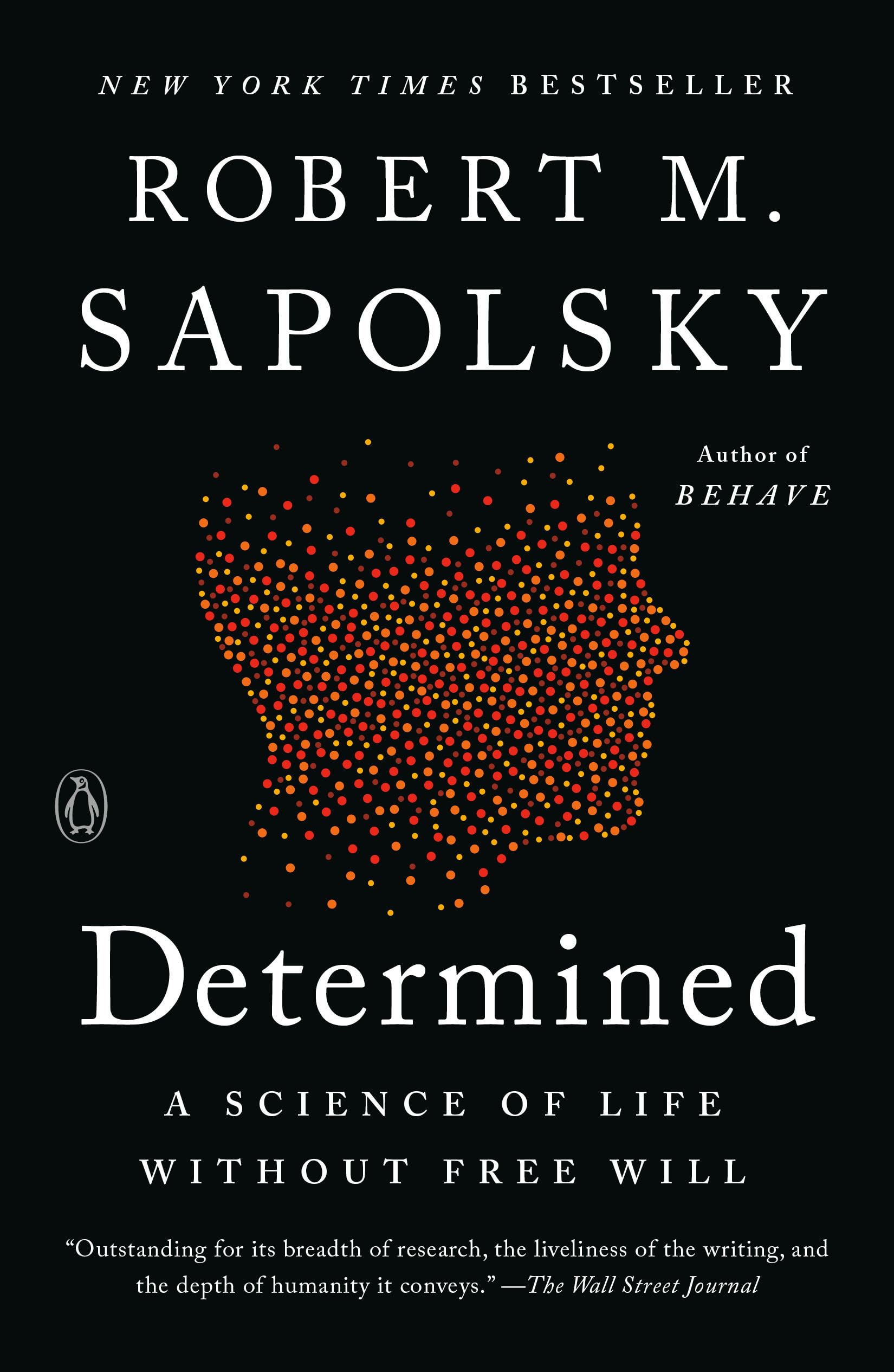
Determined: A Science of Life without Free Will
4.5 | 1,618 ratings
Price: 12.99
Last update: 11-30-2025
Product details
- ASIN : B0BSKQ5ZDM
- Publisher : Penguin Press
- Accessibility :
- Publication date : October 17, 2023
- Language : English
- File size : 41.7 MB
- Screen Reader : Supported
- Enhanced typesetting : Enabled
- X-Ray : Enabled
- Word Wise : Enabled
- Print length : 527 pages
- ISBN-13 : 978-0525560982
- Page Flip : Enabled
- Best Sellers Rank:#31,841 in Kindle Store (See Top 100 in Kindle Store)
- Free Will & Determinism
- Free Will & Determinism Philosophy
- Biology (Kindle Store)
- Customer Reviews:4.54.5 out of 5 stars(1,634)
Top reviews from the United States
- 123321A must-read for those who want to get closer to truth, wherever it leadsOne of the most radical, thought-provoking, moving, poignant, and viscerally haunting books about the human condition I've ever read.
I don't know if Sapolsky is correct that humans have no free will whatsoever--it's his philosophical interpretation of scientific facts and he admits philosophy is not his strong suit--but he makes a damn strong and formidable case not only for no free will but for the abolition of the criminal justice system, discarding the very notions of blame and praise, etc. and what might replace that.
I think this book will make anyone a more compassionate and less judgemental person just having had to wrestle with Sapolsky's arguments and all the scientific facts gathered (and he says most of the studies he cites are from the past 5 years, and he cites a lot).
For some, it will probably induce an existential crisis and challenge core beliefs that many people take for granted. Sapolsky himself approaches this with humor trying not to be too depressing and heavy, but also seriousness, he admits where he thinks he could be wrong and he struggles to wrestle with all he's learned and come to believe about the nature of the universe and our place in it in his many years as a scientist and professor (and before), and the book gets very emotional near the end with Sapolsky talking about his family members killed in the Holocaust, struggling with his own feelings of hate, experiences working with defense attorneys and their clients, etc.
The book is chock-full of science but at its core it's a professor, seeing himself as nothing more or less than another cog in a vast machine, but with a heart that cries out for humans to be more understanding of one another and society to be more just, even if that seems impossible. He himself is aware of the paradox in that and ponders it. And he's both cynical and very hopeful and optimistic. We used to burn witches, now we don't. We used to think people with schizophrenia and epilepsy were possessed by demons, now we don't. Each time subtracting responsibility and focusing on addressing root causes of behavior made society kinder. It's very political, and I suspect for a long time it's going to be hard to think about politics again without thinking about this book.
That all said, my only major critique is that I feel like looking at the objective facts of "all we are and do is heavily influenced by all that came before and we are built of components that work like machines" and concluding "there's no room for humans to have any control or agency whatsoever" is a philosophical jump that's unwarranted. Sapolsky makes a good and sincere case for why he thinks it is warranted, but I think he's not taking seriously enough what the role of consciousness might be. It seems to me if we have any agency or control consciousness would absolutely be key to that. Ironically, I feel like reading this book gave me more agency, in that knowing all the science and arguments within about constraints on human behavior enables me to make better choices (not to judge someone, to be more patient with them, to be more understanding, for example).
I'm "agnostic" on this topic (and about to read Kevin Mitchell's book arguing the opposite), but it seems to me that humans may still have some small level of control. Like, maybe "free will" is more akin to us being on a raft hastily made by people who had no idea it was supposed to last a lifetime... And we may only have one arm, but we also have a little paddle to change our trajectory ever so slightly and pew pew gun to shoot any monsters that may pop out and menace us along the way. Food for thought!
But this book is a clear 5-stars. Any disagreement shouldn't take away from that. Worth reading and owning. - High Desert Home Serves,LLCWorthy read!I gave this book five stars because it was very well researched and explained. Most people should be able to understand. Though it is helpful to have some general knowledge of the areas discussed.
Actually there is no such thing as “free”. If somebody gives you something they didn’t produce it out of nothing. If it were a physical object it had to be produced by Nature or synthesized or manufactured. These processes cost time (evolution, natural process, resource investment, etc.), energy, and if it was produced by any human involvement, cost money at some aspect of the process. If someone gives you a compliment it was not free because, for one thing, it cost money to keep that person alive, because they or someone had to pay for their food, shelter, health insurance, education, etc. Nothing is truly “free”, The notion that there’s ”free will” is misleading. Free will is not an isolated attribute. We do not live in a vacuum reality therefore there is nothing that isn’t influenced or affected by something else. Universal causation is the proposition that everything in the universe has a cause and is thus an effect of that cause. Will is basically our faculty of wishing, choosing, desiring, or intending to do or not do an act. Making a choice or decision involves drawing upon all your memories, experiences, preferences, biased point of view or beliefs, etc. Your brain utilizes both unconscious and conscious processes in order to make decisions. There is no separate isolated process of how your brain works in making a decision. There is no independent ”will” process that is free of your brain. Your brain is part of your body, and your body and mind are part of the environment in which it is located. Your mind set is affected by many factors, for instance, hunger, emotions, health condition, social pressures, memories, experiences, etc.
Yet, our decision-making process can be changed by undertaking a process of unlearning the “negative” in our psychological construct with “positive” influences. Though this may take additional support from others, such as, professional guidance, we do not have to be “doomed” by the preexisting determined influences of our past. But it does take determined effort to want to change and seek out a path of introspection and self-realization to be able to make better positive decisions. Sometimes it takes external intervention on part of family, friends, or professionals. We are social beings and do not accomplish difficult task in a vacuum.
As this book points out very clearly, to know what we all are up against in our determined dynamic reality is key to our self-awareness in exercising better choices. Part of this realization is that nobody truly has “free will”. We all have been shaped and molded by our Evolutionary and Nurture history. Moreover, daily we are being bombarded by negative propaganda and deliberate misinformation. It all affects our decision-making environment (psychology).
It is my opinion that this book is an excellent investment of time on the path to self-understanding.