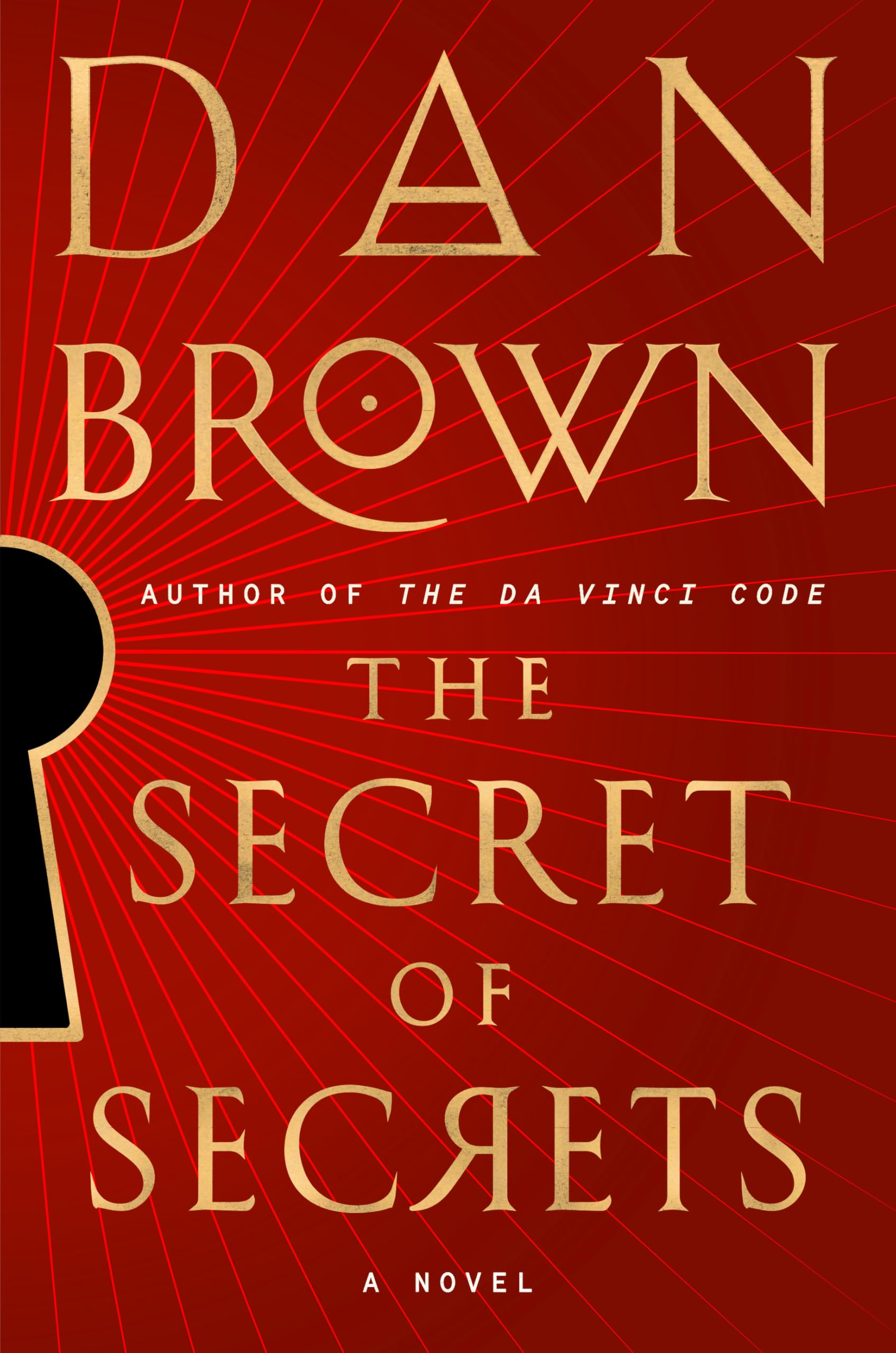
The Secret of Secrets: A Novel (Robert Langdon Book 6)
4.4 | 42,074 ratings
Price: 15.99
Last update: 12-29-2025
Product details
- ASIN : B0DTT5LV77
- Publisher : Doubleday
- Accessibility :
- Publication date : September 9, 2025
- Language : English
- File size : 8.9 MB
- Screen Reader : Supported
- Enhanced typesetting : Enabled
- X-Ray : Not Enabled
- Word Wise : Enabled
- Print length : 678 pages
- ISBN-13 : 978-0385546928
- Page Flip : Enabled
- Book 6 of 6 : Robert Langdon
- Best Sellers Rank:#71 in Kindle Store (See Top 100 in Kindle Store)
- Thriller & Suspense Action Fiction
- Technothrillers (Kindle Store)
- Technothrillers (Books)
- Customer Reviews:4.44.4 out of 5 stars(33,680)
 The Secret of Secrets: A Novel (Robert Langdon Book 6)
Top reviews from the United States
- Jeanne CoppolaFascinating and IntriguingThe Secrets of Secrets is intriguing and a little different than previous books written by Dan Brown, because the secret is about consciousness and the brain, instead of ancient symbols. The story is fast paced and intertwined with explanations of how consciousness can transcend time and space, and perhaps death itself.
In this novel, Robert Langdon, and Dr. Katherine Solomon, try to find her stolen manuscript (about how consciousness exists independent of the brain), while being perused at every turn from mysterious forces including the CIA and the government.
The story is very interesting and keeps the reader reading from one chapter to another. There are many different characters in this novel, including a “Golem” (an ancient clay monster.)
Brown’s fascinating descriptions of the different sites in Prague, makes me wish that an illustrated copy will be available soon.
Brown’s book is extensively researched. More than his other books. He includes ancient beliefs about the mind and modern attempts to understand conscious abilities. Sometimes I wondered if these modern explorations into consciousness should be discontinued because of one method the researchers were using, (and if understanding non-local consciousness would be used for nefarious purposes.) Then I realized if we knew more about consciousness, it would change our perception of reality.
Readers who studied new age beliefs should find Brown’s explanations of scientific topics more easily understood that other readers, but Brown does a very good job of explaining “non-local consciousness” and Noetic science in this book.
This is a very entertaining novel, and it puts us in awe about what our minds are really are capable of doing. - Happy ReaderA Good Read, Intriguing Information on Human Consciousness!“For years, Dr. Brigita Gessner had derided her patients’ claims of returning from the brink of death. Now she found herself praying that she could join the ranks of those rare souls who had danced to the edge of oblivion, peered into the abyss, and somehow stepped back from the precipice.
‘I can’t die… I have to warn the others.’
But she knew it was too late.’
So ends the Prologue, which makes you eager to read more.
Robert Langdon is in Prague for a lecture series. He’s gotten close to another speaker, Dr. Katherine Solomon, a “noetic scientist,” the study of human consciousness. As in, for one thing, you can’t have an after-life experience if you don’t have consciousness outside of your body. At least that’s one theory.
This book also gives you a golem, lots of chase scenes, and a very bad bad guy.
I would not recommend reading a second Dan Brown title right after reading a first one. The plot set-ups are so similar you’d think you were reading the same novel. But with sufficient time between books (and assuming you’re reading other books in between), Dan Brown delivers a fast-paced story and, the best part for me, he is chock-full of interesting information.
For example, “Secret of Secrets” brings in muscle memory, sudden savant syndrome, precognition, halos, and desert mirages. But the main arguments are for and about non-local consciousness. The YOU that makes you YOU, is not just beyond your body. It is everywhere.
You’ll need to read the book for the details. But, as Brown writes in a blurb before the Prologue (see picture), the science described in the book is real. More chillingly, the experiments are real.
4 stars. I knocked one off as there was occasionally a bit of drag in the action, and the protagonist (in a monk’s habit of course) seemed a bit of caricature. Though not perfect, this was a fun read.
Happy Reader - Richard B. SchwartzA Stunner. Welcome Back, Dan Brown.This is a stunner, perhaps the best DB book since The Da Vinci Code.
My philosophy of reviewing is that it involves three questions. What did the author set out to do? Did the author accomplish that? Was it worth doing? In the case of DB we have a specific kind of book. It has a pile-driver plot. It has interesting characters but it is not really character-driven. It is popular fiction. In addition to plot its long suits are setting and subject matter. Here we are largely in Prague, with momentary side trips to New York City.
The title refers to consciousness (Langdon’s girlfriend Katherine has written a book on the subject). Consciousness is indeed the most challenging element of brain science and it includes both scientific and spiritual dimensions of immense importance. In the novel the plot is advanced by the principal fact that Katherine Solomon’s book on the subject keeps disappearing; someone does not want this book to hit the booksellers’ shelves. Who? Why?
DB writes this story with a hand tied behind his back. He requires that the science all be right (this may make it somewhat fanciful, but not science fiction) and that the setting (also something strange and almost mystical) be rendered faithfully and honestly.
Bottom line: this is the kind of writing which requires enormous planning and research. At the same time it must be intelligible to a broad range of readers and it must be plausible.
The book succeeds on all counts. It is both the ultimate popular read and something with fascinating and important scientific/spiritual content.
It is, unmistakably, a ‘Dan Brown book’. It is not Dostoevsky; nor was it meant to be. Those who write condescending reviews of it should themselves attempt to write such a book and they should be reminded that readers can enjoy and admire a wide range of genres and styles. (Yes, I wrote this review after reading a snooty review by an individual who probably longs for an audience as wide as DB’s. And, yes, there is also some puritanism at work there. Great 18thc readers like Addison and Samuel Johnson knew that ‘honest pleasure’—the kind that will neither send you to prison nor to hell—was a great desideratum in our culture, a lesson that is often lost on those who consider such pleasure beneath them.)