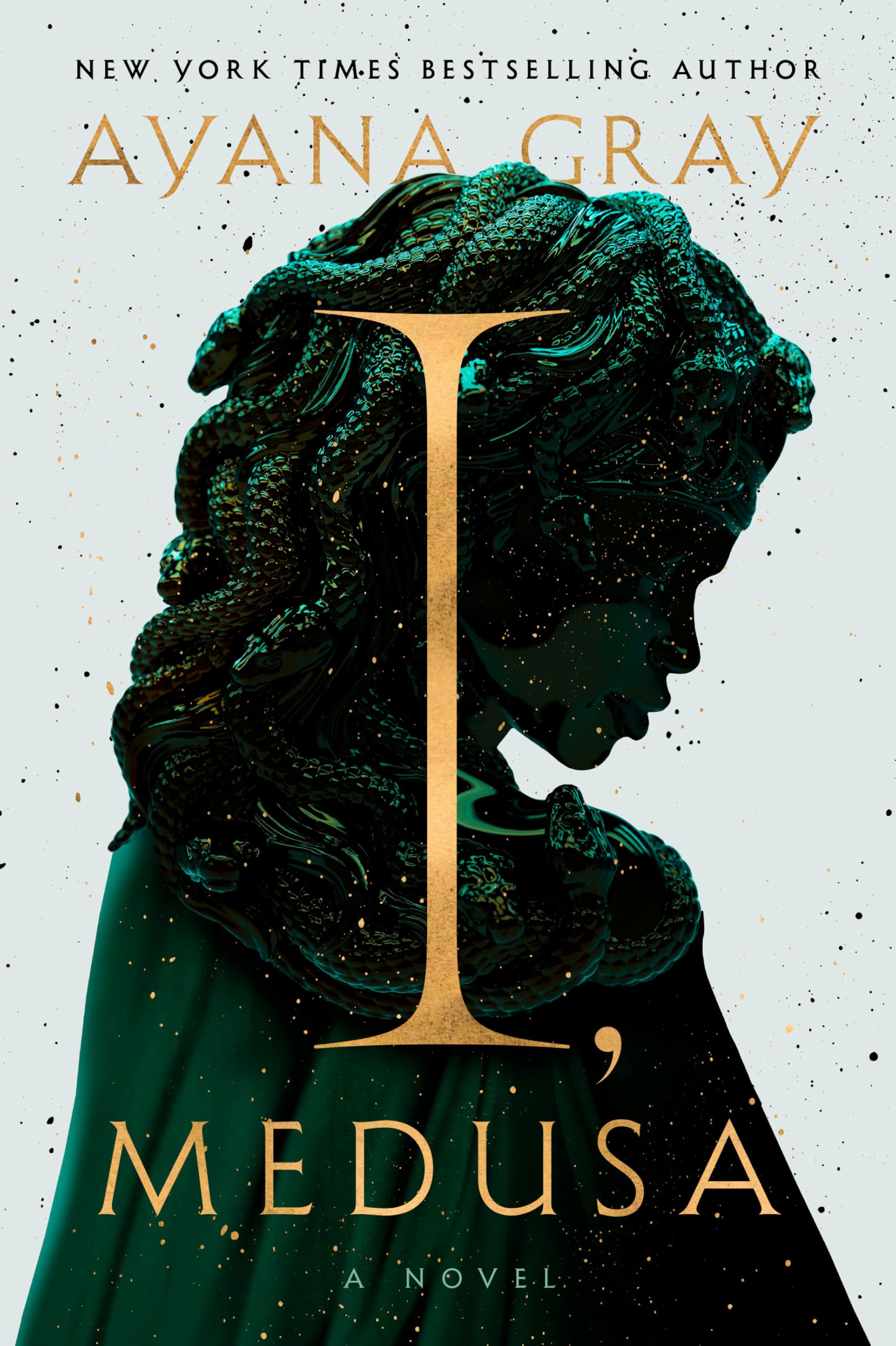
I, Medusa: A Novel
4.4 | 2,208 ratings
Price: 13.99
Last update: 03-13-2026
Product details
- ASIN : B0DXN4M668
- Publisher : Random House
- Accessibility :
- Publication date : November 18, 2025
- Language : English
- File size : 3.2 MB
- Screen Reader : Supported
- Enhanced typesetting : Enabled
- X-Ray : Not Enabled
- Word Wise : Enabled
- Print length : 319 pages
- ISBN-13 : 978-0593733776
- Page Flip : Enabled
- Best Sellers Rank:#35 in Kindle Store (See Top 100 in Kindle Store)
- Mythology (Kindle Store)
- Fairy Tale Fantasy (Kindle Store)
- Ancient Historical Fiction
- Customer Reviews:4.44.4 out of 5 stars(2,207)
 I, Medusa: A Novel
Top reviews from the United States
- DJIntriguing mixture of rage and hope‘“And how did it feel?” I start. “Feel, Your Grace?” Athena leans in, a strange new look in her gray eyes. “When you hit [him] with the goblet, how did it feel?”’ (p68)
Mortal, Maiden, Mistress, Monster. These are the section titles of this fascinating novel; while one of the four is (intentionally?) misleading, they capture well the arc of the story. This is a fascinating reworking of the classical Medusa myths, written with an intriguing mixture of rage and hope. We grow up with Medusa as she comes of age, and we follow her quest to find meaning and purpose in a world bent on cruelty and pain. Misogyny, power, and exploitation are among the dominant evils in this story, but Ms. Gray has much to say about other important matters as well.
The Medusa source material is, of course, mythology with its own rich, complex history; this novel honors that history in a way that feels like high quality historical fiction. The author reimagines, reshapes and fills in what we think we know about the original until we see it anew. It’s powerful. The final third of the book felt rushed and a bit heavy-handed, but it retains the moral complexity of the rest of the book.
You don’t need to be a classics scholar to enjoy this book. You’ll appreciate it more, however, if you take the time to look up the basics of the Medusa stories before you begin. Half the fun of reading this novel is wondering how the author is going to address the key elements of the Medusa myths that you know are coming. - FharenSolid Medusa RetellingI went into I, Medusa really excited to dive in. I had been seeing it all over my social media, and since I included it in my recommendations for books by Black authors, it naturally landed on my February TBR. I have always loved Greek mythology and have been especially fascinated by Medusa’s story, so the second I found out Ayana Gray had written a Medusa retelling, I was sold. I love when authors reclaim stories we think we know and challenge us to look at them differently.
The premise alone had me hooked, and the opening chapters pulled me in immediately. The island setting, the tension with Meddy’s parents, her strong relationship with her sisters, and the way Gray rooted the story in actual Greek mythology made the world feel both familiar and fresh. I was so invested in Meddy’s journey from her family’s small island to the sprawling city of Athens. Once she arrives, the world opens up even more. The trials, the friendships, and the slow unraveling of what it really meant to serve Athena were all so well developed. Experiencing Athens through Meddy’s curiosity made it easy to stay engaged, and I was fully invested in her transformation from sheltered girl to priestess.
Meddy is such a fascinating main character. She is sheltered, naive, angry, curious, and deeply human among a family of immortals. What stood out to me most is how much of her growth is shaped by the relationships around her. Her father’s cruelty and political ambition shrink her, while her sisters offer both protection and a mirror for the anger she tries to suppress. Her mother’s grief and bitterness toward the Olympians hang over everything, even when Meddy does not fully understand it yet. Theo represents safety and history, someone who has known her before Athens changed her, and their growing disconnect highlights how much she is evolving. In Athens, her friendship with Apollonia marks a new kind of growth for her. Apollonia is the first real female friend Meddy has outside of her family, and that connection feels significant. Through their bond, we see Meddy begin to open herself up to trust and loyalty in a way that is separate from her sisters or Theo. Athena’s approval becomes something Meddy quietly craves, even as we start to see the cracks in that devotion. And then there is Poseidon. Their dynamic is uncomfortable by design, and it should be. He is immortal, powerful, older, married, and selfish. He is not romanticized, and the lack of real consequences for him is frustratingly familiar. Men hurt women and often move on untouched. That parallel to real life is maddening.
I, Medusa has so much to say about rage, power, control, and the way women’s bodies are politicized. The reframing of Medusa’s story is powerful, and what stood out to me most was the idea of purpose. Meddy moves from being a daughter meant for marriage, to a priestess meant for service, to a monster meant for vengeance. Her arc is strong. Where it started to lose me slightly was in the later parts of the book. We get so much build up in Parts I and II, and then once Meddy is turned into the Medusa we know from myth, everything feels compressed. I kept wanting more from her relationship with her sisters after they become the Gorgon sisters, especially a clearer emotional foundation for their rage. Meddy’s anger makes sense given what she endures, but her sisters’ descent into vengeance felt less explored. I also wanted more time with Meddy living as something other than a symbol, more space to sit with who she was becoming beyond the myth.
Despite the areas where I wanted more, this was such an engaging and thought provoking read. Ayana Gray reclaims Medusa’s story in a way that feels both intimate and political, and I appreciated how unflinching she was about power and the consequences women are forced to carry. Even when I was frustrated, I was still invested. I flew through it, and it sparked so many conversations in my head about rage, justice, and who gets remembered as a monster. If you enjoy mythological retellings that center women’s voices and aren’t afraid to get uncomfortable, this is absolutely worth picking up. - Ketura MatthewsMust Read!I, Medusa is a bold, haunting, and emotionally layered retelling that finally gives one of mythology’s most misunderstood figures the voice she was always denied. Instead of portraying Medusa as just a monster with snakes for hair, this story reframes her as a victim of injustice, power, and blame — and it does so beautifully.
The writing is poetic yet sharp, capturing Medusa’s transformation not only physically, but emotionally. You feel her confusion, her anger, her betrayal, and ultimately her strength. The author skillfully challenges the traditional narrative rooted in ancient mythology, particularly the version most associated with Ovid, and instead centers Medusa’s humanity.
What makes this book stand out is how relevant it feels. Themes of victim-blaming, power imbalance, and reclaiming identity echo strongly in today’s world. Medusa is no longer just a cautionary tale — she becomes a symbol of survival and resilience.
This is a compelling read for anyone who enjoys feminist retellings of Greek mythology or stories that flip the perspective on classic legends. Powerful, tragic, and thought-provoking — I, Medusa lingers long after the final page. - AVERIRetelling a story is always a challengeIt's an enjoyable read if you don't analyze it too much. I feel it's more YA than adult. I have issues with how the two rapes were addressed. I know that my experience makes this book and the story of Medusa a difficult subject for me to take lightly. Medusa, as a character, seemed more than naive; it never felt that she came into her own power.
- ATV_ReadsRead it once for yourself, for the girl you once were, and then read it again with your daughter.Read it once for yourself, for the girl you once were, and then read it again with your daughter.
Ayana Gray has crafted a provocative and powerful origin story that transforms one of history's most iconic 'monsters' into a heroine we can all root for. Seeing Meddy flourish as an acolyte only to have her future irrevocably altered by violence—and then watching her embrace an identity as a vigilante—was deeply moving.
The themes of rage, heartbreak, and love are handled with such care. This is a story about the strength it takes to survive a world that wants to silence you. It’s a poignant reminder of why we must tell our own stories. I will be recommending this to every woman I know.